


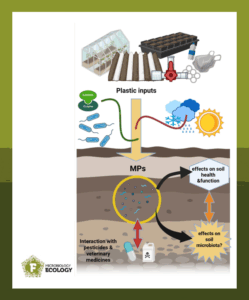
Agricultural soils are some of the largest sinks of plastic pollution, as microplastics can persist for decades. At the same time, soils are exposed to pesticides and veterinary pharmaceuticals through routine agricultural practices. Although these stressors are typically evaluated independently, soils are exposed to complex mixtures and consequently, often experience their combined effects. The study “Interactions of microplastics with pesticides and anthelminthics mediate undesirable effects on microbial nitrogen cycling in agricultural soils” published in the Thematic Issue “Microbial Ecotoxicology of Contaminants of Emerging Concern” in FEMS Microbiology Ecology, explores the cumulative impact of microplastics and agrochemicals. Stathis Lagos discusses how these interactions affect one of the most critical microbial soil processes: nitrogen cycling. #MicrobiologyIsEverywhere
Why microbial nitrogen cycling in soils matters
Nitrogen cycling underpins agricultural productivity and environmental sustainability. During this metabolic process, soil microorganisms drive nitrification, converting ammonia from the air into nitrate that plants can efficiently absorb and use for growth and crop production.
However, the same process can lead to nitrogen losses, groundwater contamination, and emissions of nitrous oxide, a greenhouse gas with a global warming potential far exceeding that of carbon dioxide. Even subtle shifts in soil microbial communities can have far-reaching consequences for both crop yields and climate regulation.
Understanding the impact of current anthropogenic activities on soil microbes and their metabolic activities was the goal of the study “Interactions of microplastics with pesticides and anthelminthics mediate undesirable effects on microbial nitrogen cycling in agricultural soils” published in FEMS Microbiology Ecology.
Tracking microbial responses across Europe
To capture realistic agricultural conditions, the study focused on soils from three contrasting European regions: France, the Netherlands, and Greece. These soils were exposed to three types of microplastics commonly found in agricultural environments, both conventional and biodegradable, either alone or in combination with widely used chemicals.
Rather than focusing solely on overall microbial diversity, the study looked at specific groups of microorganisms responsible for nitrification and denitrification. This allowed the authors to directly link pollution exposure to ecosystem functioning.
The results revealed a highly context-dependent story. In the soil sample originating from a Greek region subject to climatic stress, microplastics alone consistently stimulated nitrification. This response was linked to a marked increase in ammonia-oxidizing bacteria; a microbial group producing higher amounts of nitrous oxide compared to other nitrifiers. In practical terms, microplastics acted as an accelerator of nitrogen transformation.
However, this effect was completely reversed when the veterinary anthelmintic albendazole was present. In soils receiving both microplastics and albendazole, both nitrification rates and key microbial groups dropped sharply.
Notably, albendazole on its own did not cause such pronounced effects. Its strongest impact emerged only in the presence of microplastics. This suggests that microplastics may act as chemical amplifiers, adsorbing pollutants to their surfaces and increasing microbial exposure.
In contrast, soil samples from France and the Netherlands showed fewer and less consistent responses. These weaker effects were limited to specific sampling times, impacting nitrogen cycling and the microorganisms involved.
Based on these observations, the study suggests that soils with higher resilience may better buffer combined pollution pressure. By contrasty, Greek soil, which is more vulnerable due to climatic stress, showed marked and persistent effects.
Yet, across all soils, microorganisms involved in denitrification were largely unaffected. This selective sensitivity suggests that microplastics and agrochemicals can disrupt specific steps of the nitrogen cycle. This includes the microbial conversion of ammonia to nitrate, without uniformly affecting downstream processes like denitrification, potentially leading to long-term imbalances.
Implications beyond soil microbiology
These findings challenge the way environmental risks are currently assessed. Most regulatory frameworks evaluate chemicals individually, assuming that combined effects are predictable or negligible.
This study demonstrates that microplastics can fundamentally alter how chemical contaminants interact with soil microorganisms. The combined effects thus become stronger and qualitatively different from those caused by single stressors.
This means that introducing pollutant interactions into soil risk assessment frameworks is no longer optional, but a necessary step toward evidence-based policies that reflect complex agricultural ecosystems.
- Read the article “Interactions of microplastics with pesticides and anthelminthics mediate undesirable effects on microbial nitrogen cycling in agricultural soils” by Lagos et al. in FEMS Microbiology Ecology (2025).

Stathis Lagos is a postdoctoral researcher in the Plant & Environmental Biotechnology Laboratory at the University of Thessaly, Greece, working on the ecotoxicology of emerging contaminants in agricultural soils. He holds a BSc and MSc in Biochemistry and Biotechnology from the University of Thessaly, specializing in environmental microbiology and pesticide biodegradation. His PhD focused on the environmental fate, biodegradation, and microbial toxicity of anthelmintic veterinary drugs, revealing their effects on ammonia-oxidizing microorganisms and soil nitrogen cycling. Currently, he investigates interactions between microplastics and co-occurring pollutants and their effects on soil microbiomes using metagenomic and plasmidomic approaches.
About this blog section
The section #MicrobiologyIsEverywhere highlights the global relevance of microbiology. The section acknowledges that microbiology knows no borders, as well as the fact that microbiologists are everywhere and our FEMS network extends well beyond Europe. This blog entry type accepts contributions from excellent blogs translated into English. Regional stories with global relevance are welcomed. National or international events sponsored, organised or connected to FEMS are also covered.
| Do you want to be a guest contributor? |
| The #FEMSmicroBlog welcomes external bloggers, writers and SciComm enthusiasts. Get in touch if you want to share your idea for a blog entry with us! |