



Healthy soils are the backbone of sustainable agriculture and climate action. Yet, coarse sandy soils, common in many regions, pose a challenge. They drain water and nutrients too quickly, leaving crops thirsty and reducing yields. Improving these soils is critical for food security and carbon sequestration. The study “Effect of biochar on extracellular enzyme activity and microbiome dynamics across coarse sandy soil depths”, published in FEMS Microbiology Ecology explores an innovative solution: biochar. In this #FEMSmicroblog, Paul Iturbe-Espinoza, Rumakanta Sapkota, and Anne Winding discuss how this carbon-rich material can transform poor sandy subsoils into more resilient systems for sustainable agriculture. #MicrobiologyIsEverywhere
Biochar improves subsoil health
Agricultural soils are critical for feeding our growing population. Unfortunately, many plots are made of coarse sandy subsoils, characterized by large particle sizes and low clay content below 30 cm. These soils retain little water and have low organic matter, making them notoriously challenging and of limited use for crop growth, especially under drought conditions.
A promising solution is biochar, a carbon-rich material produced by heating biomass under low oxygen. Biochar not only improves soil structure and fertility but also contributes to carbon sequestration, making it relevant for both sustainable farming and climate mitigation.
Another crucial factor for soil health is the constitution of its microbiome as microbial diversity underpins resilience. As little is currently known about the effects of biochar on soil microbial communities, the article “Effect of biochar on extracellular enzyme activity and microbiome dynamics across coarse sandy soil depths” published in FEMS Microbiology Ecology sheds light on this question.
To investigate this, the authors analysed two Danish sandy subsoils after applying straw-derived biochar at 30–80 cm depth. These subsoil layers receive less attention in soil management, despite their key roles in water storage and root development. Over 16 months, the authors monitored changes in soil properties, microbial activity, and community composition while growing spring barley.
They observed that soil health improved after treatment with biochar: water retention improved significantly, a critical factor for crops in drought-prone regions. Soil pH also increased, reducing acidity and creating a more favourable environment for plant roots and microbes.
Biochar impacts microbial activity, diversity, and microbiome community structure in sandy soils
To analyse the activities of microbial extracellular enzymes, the study relied on fluorogenic assays. Enzymes involved in carbon cycling, such as phenol oxidase and α-glucosidase, became more active. While numerous soil microbes produce these enzymes, their increased activity suggests that the decomposition of organic matter enhanced and carbon turnover improved.
Conversely, phosphomonoesterase activity decreased, suggesting that phosphorus became more available, reducing the need for microbes to mobilize it. These functional shifts point to a more balanced nutrient environment, which benefits both plants and soil organisms. Interestingly, these changes were stronger at deeper depths, showing that biochar’s influence extends throughout the subsoil profile.
Furthermore, biochar had a pronounced effect on microbial diversity, particularly among prokaryotes. Their diversity increased significantly, with community structure shifting toward groups adapted to biochar-amended environments.
At the same time, common microbial consortia became more abundant. This included the bacterial genera Iamia and Lapillicoccus, three unknown members of the Xanthobacteraceae, Sphingomonadaceae, and Ilumatobacteriaceae families, and an archaeon belonging to Marine group II. Fungal diversity, however, remained less affected.
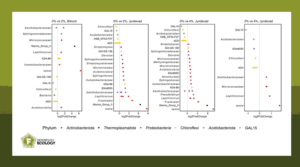
Overall, biochar creates new ecological niches for specialized microbes, increasing microbial diversity. Diverse communities can better withstand stress and maintain essential functions like nutrient cycling and organic matter decomposition in various conditions.
Biochar improves coarse sandy subsoils and climate resilience
However, challenges remain. Applying biochar to deep subsoil layers is technically demanding, while better yield is not guaranteed. Reports on negative effects on the soil microbiome also exist, and long-term effects on crop yields, soil microbiome, and overall soil health are not fully understood.
Despite these uncertainties, the observed improvements in water retention, microbial activity, diversity, and composition suggest that biochar can improve poor sandy subsoils. Offering a practical way to improve soil drought resilience and fertility, biochar has the potential to enhance both agricultural productivity and carbon sequestration – crucial for our growing population and the climate challenge.
- Read the article “Effect of biochar on extracellular enzyme activity and microbiome dynamics across coarse sandy soil depths” by Iturbe-Espinoza et al. in FEMS Microbiology Ecology (2025).
Paul Iturbe-Espinoza is a Postdoctoral Researcher at Aarhus University, specializing in soil ecology and sustainable agriculture. His PhD at VU Amsterdam investigated microbial communities associated with crude oil biodegradation in Nigerian soils. His postdoc research focuses on the effects of biochar on soil microbial communities and its role in improving soil health.
Rumakanta Sapkota is an Associate Professor in molecular ecology at Aarhus University and specializes in effects of agronomical practices on soil microbiology, plant pathology, and cross-kingdom interactions. He is integrating molecular methods, bioinformatics, and field studies to improve sustainable solutions for biological pesticide control, climate mitigation and soil health.
Anne Winding is a Professor in molecular microbial ecology at Aarhus University where she focuses on the effects of climate mitigation actions on soil microbiome, soil food web, and soil health. She combines laboratory and field work with up-date-molecular and functional tools to improve our understanding of the soil food web and the effects of changed agricultural practices to mitigate climate change.
About this blog section
The section #MicrobiologyIsEverywhere highlights the global relevance of microbiology. The section acknowledges that microbiology knows no borders, as well as the fact that microbiologists are everywhere and our FEMS network extends well beyond Europe. This blog entry type accepts contributions from excellent blogs translated into English. Regional stories with global relevance are welcomed. National or international events sponsored, organised or connected to FEMS are also covered.
| Do you want to be a guest contributor? |
| The #FEMSmicroBlog welcomes external bloggers, writers and SciComm enthusiasts. Get in touch if you want to share your idea for a blog entry with us! |