


In this third edition of our “New Microbes Discovered in 2025” series, we look at the often-overlooked fungal kingdom. From ant-manipulating fungi in Brazil to rust fungi in Pakistan, and fungi from the plastisphere in South Korea, 2025 revealed how diverse fungi are, and which ecological roles they play. Also, bamboo-dwelling species with unique morphologies caught our eye, highlighting the beauty of nature. In this #FEMSmicroBlog, Sarah Wettstadt gives an overview of new fungi from 2025. #NewMicrobes
A new fungus creating zombie ants
Zombie ants are fascinating the public, and for good reason. It is fungi from the Ophiocordyceps genus that trigger them to commit suicide.
After the fungus has infected the ant, it manipulates the animal into climbing plants or trees up to 2 m high. Here, it causes the ant to bite into the stem or leaf, dying, and, while falling down, releasing the fungal spores to the forest floor, thus creating infection hotspots.
To understand the prevalence of ant-infecting fungi in Brazil, the study “There is gold in the graveyard: a new lineage of zombie-ant fungi in the genus Ophiocordyceps (Ophiocordycipitaceae: Hypocreales) from Minas Gerais, Brazil” sampled infected Acanthoponera ants from a tropical forest reserve.
The infected ants grew up to three brown stromata, each reaching up to 4 mm in length on their necks, with dead ants piling up along the ant trails. Researchers identified the fungus Ophiocordyceps acanthoponerae and showed that it is a close relative to the wasp-manipulating pathogen Ophiocordyceps humbertii.
It is not yet clear how the fungus manages to transform these golden brown ants into suicidal zombie ants. However, discovering these entomopathogenic fungi in new parts of the world highlights their ecological and geographical distribution.
New fungi – new look
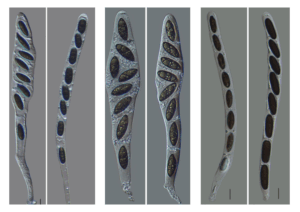
Next, we have some out-of-space-looking fungi. Researchers in Yunnan Province, China, sampled black colonies from dead bamboo and palm trees and identified new species from the Nigropunctata and Melanographium genus. In “Two new species of Nigropunctata and the first report of sexual morph of Melanographium citri (Pallidoperidiaceae, Xylariales) from south-western China“, they described their findings supported by a series of remarkable microscopic images.
The three newly identified fungi all consist of unicellular or overlapping ascomata of dark brown colour. These are cylindrical or ellipsoidal, contain clear germ slits, and are surrounded by thick mucilaginous sheaths.
Melanographium citri, Nigropunctata puerzhenensis, and Nigropunctata shiwandashanensis share similar morphologies, with only small differences in the sizes of their ascomata and ascospores. Researchers had to rely on deep phylogenetic analysis to distinguish the three species, based on which they also decided to place the genus Melanographium within the Pallidoperidiaceae family.
Marine fungi from the plastisphere
Microbial communities associated with plastic residues in marine habitats, the so-called plastisphere, are receiving increasing research interest. Several members of these communities even possess plastic-degrading capabilities.
That’s why the study “Exploring Fungal Diversity in Marine Plastic (PET) Wastes and Seafoam in Udo Island, South Korea, with Reports of Two New Species (Leptospora conidiifera and Neodevriesia oceanoplastica)” aimed to shed light on overlooked marine fungi potentially able to degrade plastic.
To do this, researchers sampled PET plastic waste and natural seafoam from the shores of Udo Island in South Korea. In total, they isolated 88 fungal strains, of which 36 species belonged to Ascomycota, 8 to Basidiomycota, and 1 to Mucoromycota. Both habitats harboured distinct fungal communities, implying unique ecological conditions.
They isolated five species for the first time in South Korea and identified two new ones. Leptospora conidiifera received its name from the Latin “conidium”, meaning asexual spore, and Neodevriesia oceanoplastica from the marine plastic habitat from which it was isolated.
Even though some of the isolated strains are known plastic degraders, the researchers did not test the new isolates for plastic-degradation abilities. If so, we may just have found new tools to combat our global plastic problem.
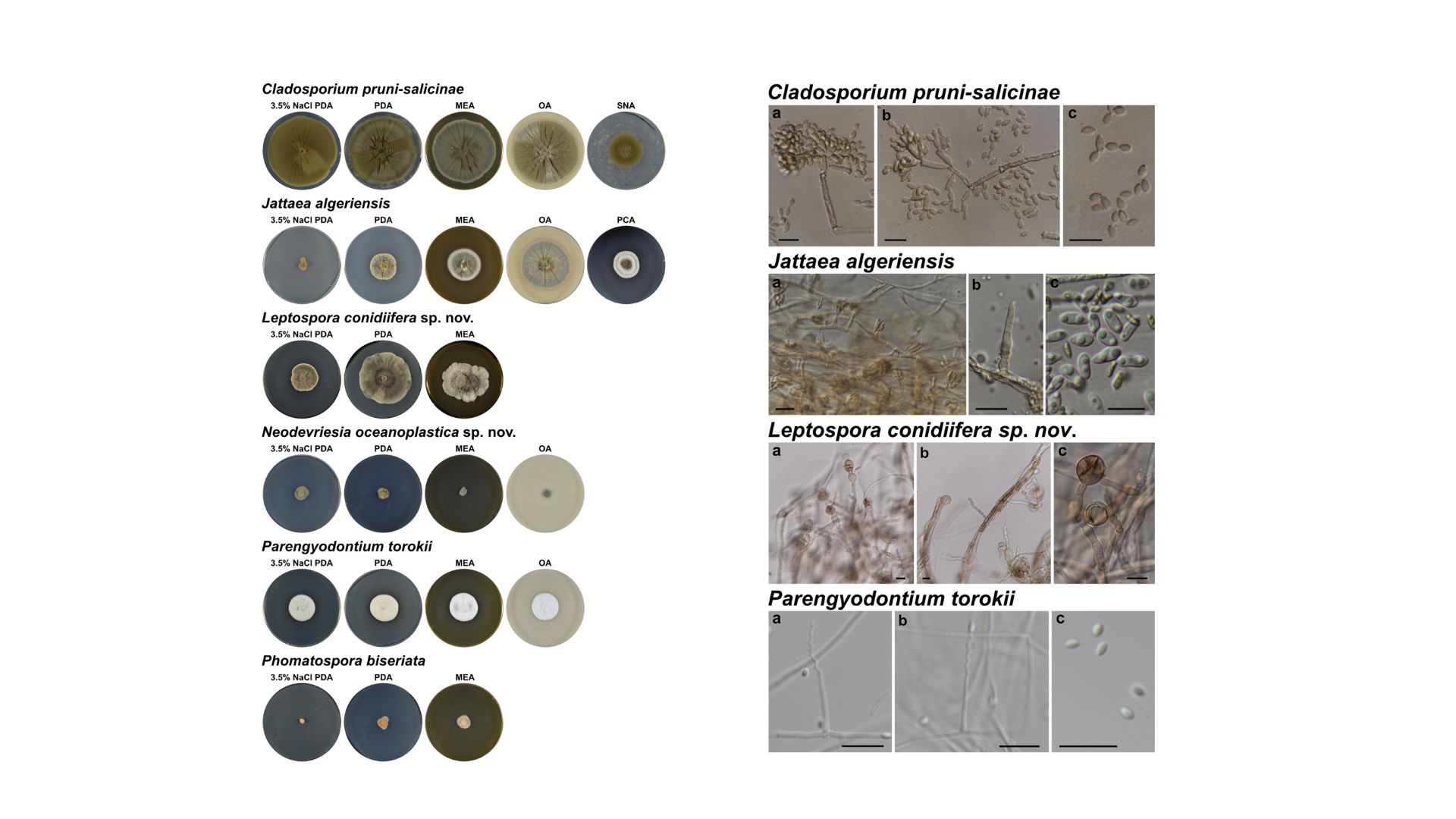
Morphologies of isolated fungal species in Lee et al. (2025). Adapted illustration.
The global diversity of rust fungi
Rust fungi are globally distributed plant parasites with wide host ranges. Infection with rust fungi from the Melampsora genus leads to white, yellow, orange, brown, or black pustules on the plant.
To better understand the diversity and global distribution of rust fungi, the study “New species and new records of genus Melampsora (Melampsoraceae) from Pakistan using electron microscopy and DNA barcoding techniques” sampled infected willow trees from an alpine meadow in Pakistan. The high altitude and moist conditions provide favourable environments for fungal plant pathogens.
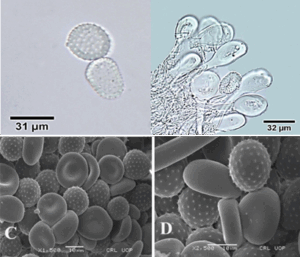
The scientists isolated two Melampsora species for the first time in Pakistan, highlighting the geographical distribution of these pathogens. The newly identified species Melampsora himalayensis produced yellow to orange colonies with diameters of 0.2 to 0.4 mm on leaf surfaces.
Closely related to Melampsora idesiae and Melampsora laricis-epitea, Melampsora himalayensis has larger urediniospores and paraphyses. While its impact on the disease is not understood yet, its discovery showcases the genetic diversity of rust fungi.
Welcome to the new fungi identified in 2025
Here, we discussed a few examples of the fascinating fungal diversity found in 2025 — from plant fungi with unique morphologies to marine plastic degraders, as well as rust fungi and ant-manipulating pathogens expanding their geographical range. These discoveries underscore the broad and still unexplored fungal diversity and their crucial ecological roles in global environments.

Dr Sarah Wettstadt is a microbiologist-turned science writer and communicator writing for professional associations, life science organisations and researchers from the biological sciences. She runs the blog BacterialWorld to share the diverse and colourful activities of microbes and bacteria, based on which she co-published the colouring book “Coloured Bacteria from A to Z“. As science communication manager for the Scientific Panel on Responsible Plant Nutrition and blog post commissioner for the FEMSmicroBlog, Sarah writes about microbiology and environmental topics for various audiences. To help scientists improve their science communication skills, she co-founded SciComm Society. Prior to her science communication career, Sarah completed a PhD at Imperial College London, UK, and a postdoc at the CSIC in Granada, Spain. In her non-scicomm time, she enjoys playing beach volleyball on the sunny beaches in Spain or travelling the world.
About this blog section
Each year, the #NewMicrobes series for the #FEMSmicroBlog explores new species discovered throughout the year. Through several posts, we highlight the microbial diversity across all kingdoms by showcasing newly identified bacteria, viruses, fungi, and archaea.
| Do you want to be a guest contributor? |
| The #FEMSmicroBlog welcomes external bloggers, writers and SciComm enthusiasts. Get in touch if you want to share your idea for a blog entry with us! |