

What do mold on your bread and the soil of a rice field have in common? Both can contain fungal pathogens capable of threatening humans, animals, and environmental health. Even though only a small group of fungi poses serious global risks, 19 fungal pathogens have made it onto WHO’s Fungal Priority Pathogen List, given their presence in many countries poorly documented. The article “Uncovering the Hidden Threat: WHO Fungal Priority Pathogens in Indonesia – A Systematic Review” published in FEMS Microbiology Letters uncovers how these pathogens appear across Indonesian ecosystems and why they often go undetected, as discussed by Niar Ibrahim Rose. #MicrobiologyIsEverywhere #OneHealth #WorldHealth
Why surveillance of fungi matters
Fungal infections are an underrecognized global health challenge, causing more than 1.6 million deaths each year. That’s why in 2022, the WHO introduced the Fungal Priority Pathogen List, which includes 19 fungal groups and species posing significant risks to human health. Ranked and categorized into three priority groups, these pathogens cause severe illness, are often hard to detect, and show increasing resistance to available antifungal drugs.
Since Indonesia is a tropical country with rich biodiversity and a rapidly changing landscape, it provides ideal conditions for fungi to thrive. There, deforestation, plantation expansion, mining, and intensive agriculture create new opportunities for fungi to spread.
Many fungi from the priority list are found in rice, maize, and other crop systems. The heavy use of azole-based fungicides in farming has also contributed to the spread of antifungal resistance. This eventually affects human health and is a clear One Health concern.
Additionally, fungal diseases disproportionately impact people with weakened immune systems, including those with cancer, HIV/AIDS, tuberculosis, or lung conditions. In Indonesia, where these health challenges are already common, undetected fungal infections can lead to severe complications or death.
The review “Uncovering the Hidden Threat: WHO Fungal Priority Pathogens in Indonesia – A Systematic Review” published in FEMS Microbiology Letters aims to clarify which WHO-listed fungal pathogens have been found in Indonesia, where they occur, and what this means for public health.
Fungal priority pathogens in Indonesia
From 825 publications published over the past 25 years, the authors identified 79 studies documenting 110 records of WHO Fungal Priority Pathogen List-related fungi in Indonesia. These studies cover both clinical settings and environmental samples, including soil, crops, bird droppings, aquaculture ponds, and households.
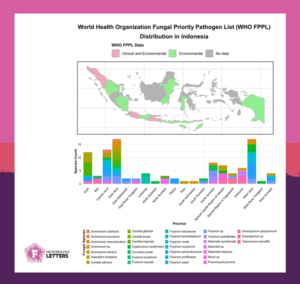
Of the 19 species on the Fungal Priority Pathogen List, Indonesia hosts nearly all priority groups. Yet some pathogens have never been officially reported.
Furthermore, medium-priority species, such as Fusarium, Acremonium, and Curvularia, dominate the records. These fungi are common in agricultural and natural environments and easier to detect with basic laboratory methods. At the same time, critical-priority pathogens, including Aspergillus fumigatus, Candida tropicalis, and Cryptococcus neoformans, are present in both the environment and hospitalized patients.
Fungal hot spots are concentrated in Java and Sumatra, while 16 of 34 provinces have never reported any species from the Fungal Priority Pathogen List. These “empty” areas likely reflect a lack of study rather than a lack of fungi.
Where Indonesia faces ongoing challenges
The review continues by highlighting the challenges Indonesia faces in detecting and monitoring fungal diseases. In some settings, limited access to advanced diagnostic tools can make early identification of high-risk fungal infections difficult.
Hence, establishing surveillance sites in provinces that are currently underrepresented may help ensure that fungal threats are detected more evenly across the country. Expanding access to modern diagnostic methods, such as molecular testing, would allow faster and more accurate identification of dangerous fungi.
Surveillance efforts are also uneven: Most available data come from a small number of well-resourced provinces, while information from other regions remains limited. Integrating fungal surveillance into existing public health systems would improve national and international reporting.
Most importantly, closer collaboration between medical, veterinary, agricultural, and environmental sectors under a One Health approach would help capture the full picture of fungal risks. Creating a national fungal database could further support early warning systems and rapid responses to emerging outbreaks.
In summary, this review provides the first nationwide synthesis of WHO-listed fungal pathogens in Indonesia and offers an evidence-based foundation for national preparedness, research prioritization, and One Health–driven policy action.
- Read the article “Uncovering the Hidden Threat: WHO Fungal Priority Pathogens in Indonesia – A Systematic Review” by Ibrahim et al. in FEMS Microbiology Letters (2025).

Syahriar Nur Maulana Malik Ibrahim is a Ph.D. student under Dr. Nuttapon Pombubpa at the Department of Microbiology, Chulalongkorn University. Her research focuses on fungal and bacterial exploration using polyphasic identification and omics-based approaches to understand their roles in environmental, clinical, and industrial contexts. She works in the Nat Pombubpa Lab, where she investigates pathogenic reservoirs using metagenomics, HPCC pipelines, and R-based analyses. Her expertise also includes microbial isolation, anti-microbial tests, and the development of bio-based products such as hydrolase enzymes, biosurfactants, and oligosaccharides.
About this blog section
The section #MicrobiologyIsEverywhere highlights the global relevance of microbiology. The section acknowledges that microbiology knows no borders, as well as the fact that microbiologists are everywhere and our FEMS network extends well beyond Europe. This blog entry type accepts contributions from excellent blogs translated into English. Regional stories with global relevance are welcomed. National or international events sponsored, organised or connected to FEMS are also covered.
| Do you want to be a guest contributor? |
| The #FEMSmicroBlog welcomes external bloggers, writers and SciComm enthusiasts. Get in touch if you want to share your idea for a blog entry with us! |