



Mountain areas are complex ecosystems with varied functions and services, such as supplying clean water to downstream regions. Water quality depends not only on climate and atmospheric inputs but also on soil processes—especially those driven by microorganisms. The study “Contrasting nutrient retention in alpine soils: the role of soil microbiome in phosphorus and nitrogen mobility in scree and meadow environments” in FEMS Microbiology Ecology in the Thematic Issue “Ecology of Soil Microorganisms” investigated how two common alpine soil types differ in their abilities to retain nutrients, as explained by Eva Kastovska in this #FEMSmicroBlog. #MicrobiologyIsEverywhere
Contrasting soils, contrasting functions
Due to the complex topography, alpine landscapes are highly diverse. They include a continuum of surface types, ranging from completely bare rock and stone surfaces, through soils in very early stages of soil formation, to more developed, vegetation-covered meadow soils.
Scree soils are young soils in the earliest stages of soil development: small, discontinuous pockets of weathered material that accumulate between rocks. They often have limited access to light, little or no vegetation, very low organic matter, and, thus, relatively small amounts of microbes.
As water redistributes this young soil, it accumulates in more stable positions. Here, plants may colonize it, leading to the formation of small alpine meadow patches. As meadow soil is enriched in organic material and plant root networks, it harbours more diverse microbial populations.
In the alpine zone, these stages form a natural gradient of soil development, with scree and meadow soils representing two contrasting but closely connected endpoints.
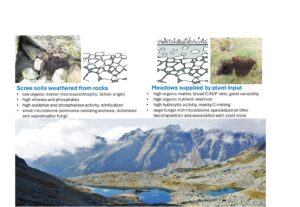
The study “Contrasting nutrient retention in alpine soils: the role of soil microbiome in phosphorus and nitrogen mobility in scree and meadow environments” published in FEMS Microbiology Ecology aimed to understand how these differences influence the behaviour of soil nutrients. To investigate this, the researchers of the study collected soil samples from several scree slopes and alpine meadow patches in high-elevation mountain catchments in the Tatra Mountains of Slovakia and evaluated nutrient leaching based on chemical analyses, microbial community structure, and soil enzyme activity.
The microbial mechanisms behind nutrient mobility
Bacteria and fungi dominated both alpine soil types, as expected in harsh, oligotrophic, and often acidic environments. Yet, their composition differed markedly.
Microbial communities in scree soils were enriched in taxa characteristic of early-stage, low-organic environments, including candidate phyla such as Candidatus Dormibacterota and Eremiobacteria. These organisms are adapted to nutrient-poor conditions through slow growth, stress tolerance, and in some cases autotrophy. Notably, ammonia-oxidizing archaeal groups such as Nitrosotaleales and Nitrososphaerales were more abundant, indicating enhanced nitrification potential.
Identified lichen-forming fungi, like Acarosporales, Lecanora, and Rhizocarpon contribute to early carbon inputs, mineral weathering, and phosphorus release. Saprotrophic fungi such as Mortierella (Linnemannia) further recycle organic material. These communities show high biomass-specific activity, including elevated phosphatase activity, enhancing phosphorus mobilization and leakage.
Scree soils have a limited capacity to retain nutrients as they contained higher concentrations of mobile nitrate and phosphate and exhibited significantly greater phosphorus leaching. Low organic matter content, weak phosphate sorption, and the absence of lichens and mosses to take up nutrients lead to their leakage into downstream waters.
In contrast, meadow soils retain nutrients more efficiently. They contain larger microbial biomass and more complex communities linked to plant interactions. Fungal communities were dominated by litter and soil saprotrophs as well as root-associated taxa, including mycorrhizal fungi, Glomeromycota, and Archaeorhizomyces.
Their bacterial communities were enriched in groups such as Acidobacteriota, Frankiales (e.g. Acidothermus), and members of Burkholderiales and Hyphomicrobiales. These groups are mainly involved in plant growth promotion and nitrogen cycling.
These communities promote nutrient retention as they incorporate and recycle nutrients into organic matter or support their uptake into plants. The higher enzymatic activity of meadow soils reflects active decomposition of plant material and internal nutrient cycling.
Why nutrient mobility matters in a changing climate
Alpine regions are particularly sensitive to environmental change. Increasing temperatures, altered precipitation patterns, and enhanced atmospheric nutrient deposition are already affecting soil formation.
This study suggests that as the balance between scree and meadow habitats shifts, so do their microbial communities. This could significantly alter nutrient export from mountain catchments with increased nutrient leaching potentially impacting downstream water quality, including alpine lakes and drinking water sources.
Overall, the study shows that soil microorganisms are key regulators of nutrient mobility in alpine ecosystems. As such, they influence water quality at the landscape scale and actively shape how ecosystems function.
- Read the article “Contrasting nutrient retention in alpine soils: the role of soil microbiome in phosphorus and nitrogen mobility in scree and meadow environments” by Kastovska et al. in FEMS Microbiology Ecology (2026).

Eva Kaštovská is a soil ecologist at the University of South Bohemia in České Budějovice, Czech Republic, focusing on plant–soil–microbial interactions in terrestrial ecosystems. Her research explores how plant-derived inputs shape microbial communities and drive the cycling of carbon, nitrogen, and phosphorus in soils. For more than 15 years, she has been studying mountain and alpine ecosystems, with a particular interest in how these fragile systems respond to environmental change, including climate change, recovery from acidification, and nutrient enrichment. Her work links soil processes to downstream aquatic systems, such as mountain lakes, and examines how soil processes affect nutrient retention and leaching. She combines field and laboratory experiments with stable isotope techniques to better understand ecosystem functioning.
About this blog section
The section #MicrobiologyIsEverywhere highlights the global relevance of microbiology. The section acknowledges that microbiology knows no borders, as well as the fact that microbiologists are everywhere and our FEMS network extends well beyond Europe. This blog entry type accepts contributions from excellent blogs translated into English. Regional stories with global relevance are welcomed. National or international events sponsored, organised or connected to FEMS are also covered.
| Do you want to be a guest contributor? |
| The #FEMSmicroBlog welcomes external bloggers, writers and SciComm enthusiasts. Get in touch if you want to share your idea for a blog entry with us! |