


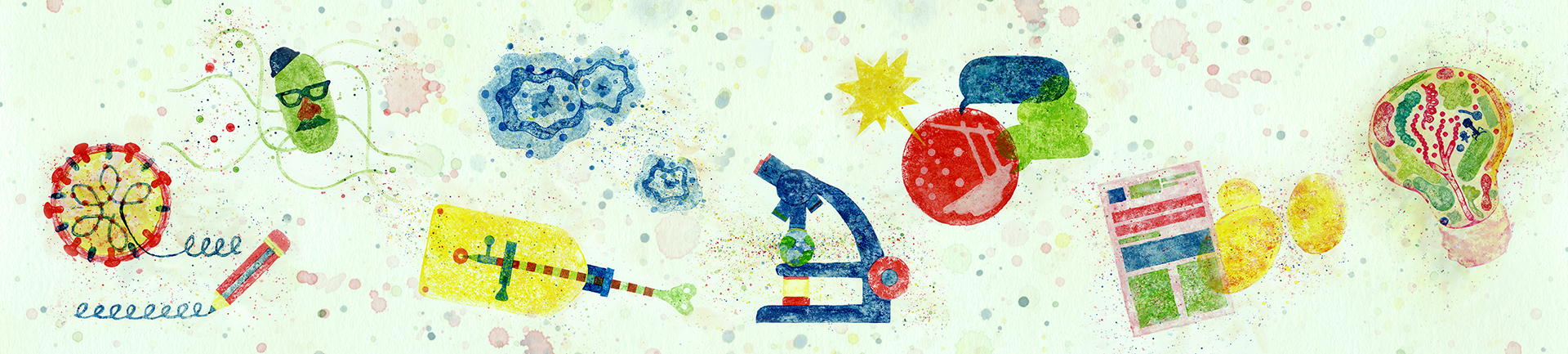
The incredibly vast amount of information available at a click, and the recent speed and scale of scientific and technological change can feel overwhelming. As scientists and educators, we need to ramp up our efforts to support everyone in developing the necessary science and information literacy, and to help regain trust in science. Such current educational efforts are presented in the FEMS Microbiology Letters virtual Thematic Issue “Learning together for our future”. Beartix Fahnert gives an overvoew over its papers and how they cover public engagement with microbiology, active and authentic learning in preparation of future professional and civic contributions, as well as service learning. #TheCulturePlate
We need to stay curious
Why? What? How?
Children can have what seems an endless stream of questions, and we often struggle providing an answer, or let alone a good answer. At least we used to struggle in those days before the internet.
Then, growing up, many curious minds picked careers, such as scientists and educators, that are all about asking questions, finding, and sharing answers.
We as humans like to ask questions, because we are inquisitive and want to understand what we don’t know. We want to drive progress for the benefit of everyone. Yet, just identifying the right (research) questions can be challenging, never mind finding an answer or new information. It is rewarding, but it is hard work and it takes time.
Nowadays, the amount of information available at our fingertips is rapidly growing. Just keeping up has become hard work. The even bigger challenge is separating fact from fiction, like misinformation, fake news, and fake science.
That’s why it has become ever more important to be able and willing to make evidence-based decisions and evaluate the information we use. Yet worryingly, we observe the opposite approach even for decisions that are critical for our health or that of our planet. Opinions and influencers are being trusted, but not the work of scientists and the rigour they apply. Unsurprisingly, we already face the consequences: cases of vaccine-preventable diseases are increasing in the wake of vaccine hesitancy and declining vaccine uptake.
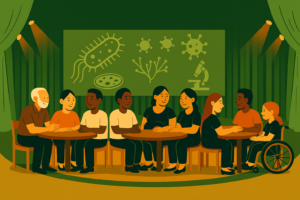
Helping society finding answers
Well, even using the internet, it seems we are struggling to find answers,especially good ones. While information has become quicker to access and seemingly easier to find, finding good answers requires information literacy and science literacy, including microbiology literacy.
We, as scientists and educators, have the responsibility to support society in developing these literacies towards finding evidence-based answers. The goal is for everyone to understand how scientists, as a community, produce reliable knowledge, which can help rebuild or maintain trust in science, and therefore, judge the credibility of a source or information.
This quest requires co-ordinated and impactful action in various educational settings, as explored in the Thematic Issue “Learning together for our future” in FEMS Microbiology Letters. These public engagement opportunities include from curriculum development for formal education, engaging and empowering learners, reaching people outside formal education whatever their background, to involving policymakers and funders.
Scientists need to be visible, and their messages need to be clear. To achieve that, inclusive and creative science communication and outreach initiatives are powerful tools.
We cannot stop at information and science literacy though. We need to (re)instil curiosity and the motivation to enquire. Otherwise, the easy answers are all too tempting, and what we achieved in the past will get lost.
We all need to learn together for our future – with science at the centre stage. Let us curate information, protect scientific rigour, foster dialogue, and respectful constructive debates!
- Read the article “Learning together for our future” in the virtual Thematic Issue “Learning together for our future” in FEMS Microbiology Letters (2025).
About the author of this blog
Beatrix Fahnert is a microbiologist and educator, currently a Professor and Deputy Dean (Education) of the Faculty of Science and Engineering at Anglia Ruskin University. She is committed to sharing her passion for science, providing engaging inclusive education, preparing students for careers, and supporting other educators. Her work focuses on educational development in STEM. She is a textbook author and Senior Editor for Professional Development in FEMS Microbiology Letters.
About this blog section
The section #TheCulturePlate for the #FEMSmicroBlog aims to bring science closer to different audiences and to tell more about the scientific or personal journey to come to the results.
| Do you want to be a guest contributor? |
| The #FEMSmicroBlog welcomes external bloggers, writers and SciComm enthusiasts. Get in touch if you want to share your idea for a blog entry with us! |