


Water is essential to life on planet Earth as all organisms depend on it. Because of its dipole moment, water can dissolve more substances than any other liquid, with a particular affinity for water-loving ionic and polar covalent compounds. However, because it still interacts with water-repelling compounds, it is at the core of many biochemical reactions; some of them crucial for life, like photosynthesis and cellular respiration. At the same time, it serves as a transport medium for sugars, proteins, and nucleic acids and influences how microorganisms live, interact, and drive key processes in natural and engineered water systems. For this World Water Day, Danelle Botha highlights the relationships between water, microbes, and humans. #MicrobiologyEvents
Microbes’ relationship with water
Since all organisms depend on water, this inevitably includes microorganisms, whether they are water-loving or water-repelling. Water-loving, hydrophilic cells interact with water and adhere to hydrophilic surfaces, while water-repelling, hydrophobic cells repel water and adhere to hydrophobic surfaces.
To survive under varied environmental conditions, microbes rely on their cell surface hydrophobicity which determines how well the cell immobilises on surfaces. In general, microbes love sticking to both biotic or abiotic surfaces: to each other, to activated sludge in the wastewater treatment process, and even to pollutants!
However, microbes don’t love sticking to rules. Within a single population, one can find both hydrophobic and hydrophilic cells with some even switching depending on their growth phase or environmental conditions.
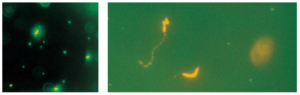
The study “Determination of bacterial cell surface hydrophobicity of single cells in cultures and in wastewater in situ” in FEMS Microbiology Letters used fluorescent microspheres to determine the cell surface hydrophobicity of wastewater community members. Some structures, like bacterial filaments, showed different cell surface hydrophobicity compared to single cells, with increased microsphere attachment.
Even though most free-living cells within the community were hydrophilic, increased cell surface hydrophobicity was important for forming granules and attaching to sludge flocs. For example, Gram-negative bacteria can increase their cell surface hydrophobicity by releasing outer membrane vesicles enhancing attachment, biofilm formation capability, and thus potentially pathogenicity. This mixed behaviour is conserved across bacteria, archaea, and fungi.
How microbes support sustainable water resource management
Microorganisms with a high cell surface hydrophobicity more readily accumulate and break down aromatic and xenobiotic compounds. In contrast, hydrophilic microorganisms are more resistant to the toxic effects of organic hydrophobic chemicals and can therefore, more readily break down organic waste in their presence. This ability plays an important role in bioremediation.
For example, managed aquifer recharge is an artificial bioremediation process used to manage water systems. Groundwater sources are recharged with excess water, including surface or potable water, treated/recycled wastewater, or even desalinated seawater. This helps maintain adequate water levels while also treating wastewater and improving groundwater quality.
However, as Dutch microbiologist Lourens Baas Becking stated: “Microbes are everywhere, and the environment selects”. Hence, their presence in groundwater makes it crucial to understand how managed aquifer recharge impacts both groundwater properties and microbial communities.
The article “Bacterial community and groundwater quality changes in an anaerobic aquifer during groundwater recharge with aerobic recycled water” in FEMS Microbiology Ecology investigated the organisms within the sediment of a major confined anaerobic sedimentary aquifer. The most abundant groups were Alphaproteobacteria, Gammaproteobacteria, and Betaproteobacteria with gene sequences related to oxidising reduced sulphur compounds, denitrification, and metabolising pollutant carbon sources like polycyclic aromatic hydrocarbons. These properties could aid in improving the quality of water reclaimed from the aquifer.
Treatment and protection technologies
Bioremediation using fungi is another promising and sustainable option to clean intertwined soil and water systems. For example, fungal networks can break down pollutants rendering them less or even non-hazardous. Resinicium bicolor, a white-rot wood decay fungus, can redeposit absorbed strontium in calcium oxalate to increase its availability to other organisms.
Another approach relies on the sorption properties of fungal mycelia to immobilise and accumulate pollutants. For example, melanin absorbs and transforms energy from radionuclides. This protects the fungus from ionizing radiation. Even dead fungal mycelia can absorb a variety of metal ions, making them useful filters for treating industrial wastewater, as previously observed for Rhizopus arrhizus.
In the “wild boar paradox”, the deer truffle Elaphomyces granulatus, a fungus with underground fruitbodies, accumulates radiocesium. After nuclear fallout events, wild boars eat the fungus, with radiocesium accumulating in their meat and making it unusable as a source of game meat. Collecting the fruitbodies would remove the radionuclide pollutants from contaminated sites and prevent bioaccumulation or leaching into groundwater sources.
Will your drop cause a ripple?
Everyone depends on water and today we would like to thank it for “solving” so many things. Water is at the core of biochemical reactions that make life possible.
But are we genuinely trying to protect this precious resource? We cannot clean it at a rate slower than polluting it.
Will we act before deteriorating water quality becomes a global crisis? Or are we going to invest in long-term studies and monitor the response of the water systems to disruptions?
Are we going to empower ourselves to better understand and therefore support our water systems and their related microbial communities to do what they do best and sustain us?
Whether you’re a researcher or not: Think about which small or big questions you can tackle, steps you can take, or how to be more mindful of what you put into the medium that SUSTAINS YOU! Happy World Water Day!
- Read the article “Bacterial community and groundwater quality changes in an anaerobic aquifer during groundwater recharge with aerobic recycled water” by Maneesha et al. (2013) in FEMS Microbiology Ecology
- Read the article “Determination of bacterial cell surface hydrophobicity of single cells in cultures and in wastewater in situ” by Zita and Hermansson (1997) in FEMS Microbiology Letters
- Read the article “Fungi and ionizing radiation from radionuclides” by Dighton et al. (2008) in FEMS Microbiology Letters
Danelle Botha is an applied and environmental early-career microbiologist pursuing her Ph.D. in Microbiology at Stellenbosch University, South Africa. Mentored by Prof. Gideon Wolfaardt and Dr Christoff Truter under the Stellenbosch University Water Institute (SUWI), her work is committed to finding low-cost, implementable solutions for ever more pressing challenges in the water sector. Her research focuses on using synthetic biology to engineer fungal biofilms as biological early warning systems for water quality monitoring. She is investigating using automated online biosensors, that detect ecotoxicity and endocrine disruptive potential, to complement conventional water quality analysis techniques.
The section #MicrobiologyEvents for the #FEMSmicroBlog reports about events and meetings relevant to our network. These include world awareness days, FEMS-sponsored meetings or meetings of Member Societies and many more.
| DO YOU WANT TO BE A GUEST CONTRIBUTOR? |
| The #FEMSmicroBlog welcomes external bloggers, writers and SciComm enthusiasts. Get in touch if you want to share your idea for a blog entry with us! |