

FEMS Microbes
Home for sound microbiology research that moves the field forward, step-by-step
FEMS Microbes provides an open access home for sound, peer-reviewed microbiology research from across the field, strengthening the overall evidence base. Every accepted contribution is evaluated for the quality and reproducibility of the science, and for how the findings move the field forward, whether through major insights or micro-advances. With its community-focused ethos, FEMS Microbes offers a trusted space to publish, gain visibility, and grow your scientific network. It’s a journal that supports established investigators and the next generation of microbiologists. A place to build community, confidence, and credibility within a supportive community.
Editor-in-Chief: Dr. Breck Duerkop, University of Colorado; Prof. Jana Jass, Örebro University; and Prof. Kathleen Scott, University of South Florida
Highlights: Open access | Spanning the full breadth of microbiology | Format-free submission | Scooping Protection | Transparent peer review options


- Why choose FEMS Microbes ?
- Is your research the right fit?
- Recent highlights
- Quick facts
- Meet the Editors-in-Chief
- Publish with purpose. Publish with FEMS
Why choose FEMS Microbes?
✅ Open access for maximum visibility and uptake
All articles are fully open access, ensuring your work is immediately available to the global microbiology community without subscription barriers.
✅ Progressive publishing policies
Built on author-friendly policies with format-free submission, scooping protection, preprint posting, recognition for co-reviewers, and transparent review policies.
✅ Rigorous science, evaluated by experts
Manuscripts are handled by active researchers with deep subject expertise. The journal recognises and values well-supported, reproducible advances, including major scientific discoveries and micro-advances that strengthen the field.
Is your research the right fit?
FEMS Microbes actively encourages studies that add to the scientific record by clarifying, confirming, or challenging existing knowledge.
We look for submissions with:
- Rigorous methods
- Reproducible experimental data
- Robust statistics
- Timely data that is relevant to the field
And are interested in:
- Additional data that strengthens a larger dataset
- Confirmatory data in an understudied field
- Contradictory results that provide a new perspective or challenge the status quo
- Papers that present a new insight using a publicly available dataset
Within this broad scope, the journal particularly welcomes papers that tell a strong story about how the data moves the field forward.
FEMS Microbes welcomes high-quality microbiology research across the full breadth of the field, including the topics below
Microbes & Metabolism
Embracing the numerous levels of microbial metabolism, from enzymes, pathways and metabolic networks to physiology and metabolomes.
Microbes & Multicellular Life
Including all topics related to biofilms and microbial communities, microbiomes, and microbe-microbe interactions.
Microbes & Disease
Encompassing epidemiological, biological, cellular and molecular aspects of host-microbe interactions, zoonosis, emerging pathogens and host responses.
Microbes & Environment
Covering diverse aspects of microbial ecology including community structure-function relationships, regulation, sensing and environmental responses, and biotic-abiotic interactions.
Microbes & Society
Exploring the beneficial and detrimental roles of microorganisms in biotechnology, food and industrial microbiology, antibiotic resistance, vaccines, security, sustainability, and microbial forensics.
Still unsure? Get in touch to discuss your manuscript’s suitability before submission at info@fems-microbiology.org.
Recent highlights
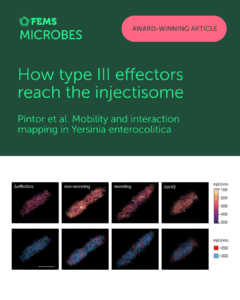
Pintor et al. dissect how type III effectors are targeted to the injectisome, revealing a cytosolic handover mechanism in Yersinia enterocolitica.
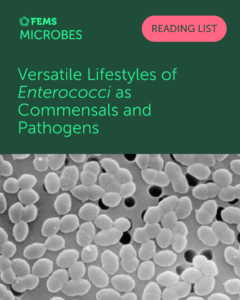
Thematic Issue: Versatile Lifestyles of Enterococci as Commensals and Pathogens
Collection comprehensively examining various aspects of enterococci biology, from genetics and metabolism to antimicrobial resistance and biotechnological applications.
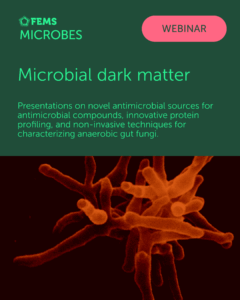
Recent webinar: Microbial dark matter
Recent webinar diving into the underexplored areas within microbiology.
Meet the Editors-in-Chief

Dr Breck Duerkop

Prof. Jana Jass

Prof. Kathleen Scott
Quick facts
- Publishing Model: Open access
- Article Types: : Full-length research articles and short reports of broad significance in the field of microbiology and related disciplines
- Review Process: In support of open science and greater transparency, FEMS Microbes offers Transparent Peer Review. Authors may choose to publish peer-review reports and responses alongside their article, and reviewers may opt to disclose their identity. Both options are voluntary and independent.The journal also recognises the important contributions of Early Career Researchers through its co-reviewer initiative. Invited reviewers may collaborate with PhD students or postdocs in preparing reports, providing mentorship in the process. Co-reviewers can receive formal recognition for their contribution, including credit via Web of Science Researcher Profiles.
Publish with purpose. Publish with FEMS.
The FEMS journal portfolio spans the full spectrum of microbiology, publishing rigorous, society-backed research from fundamental discovery to real-world application.
Stay updated on interesting reads, publishing opportunities, and more by signing up for the FEMS newsletter.

Open access is key to supporting the FEMS mission of disseminating high quality research as widely as possible: when high quality, peer reviewed sound science is open access, anyone, anywhere in the world with an internet connection, can read it. All but one of the not-for-profit FEMS journals are fully open access (OA), with one journal, FEMS Microbiology Letters, offering free-to-publish and OA options.