


In the human gut, microbes interact with each other. The idea is that commensals protect the host from overgrowth of pathogenic organisms. The article “Phocaeicola vulgatus mpk colonization protects epithelial cells from Candida albicans infection” in the Thematic Issue “Infection biology of human-pathogenic fungi” in microLife investigated the interactions between one important opportunistic pathogen with a highly abundant commensal. Merle Hammer explains for the #FEMSmicroBlog how Phocaeicola vulgatus protects human epithelial cells through multiple mechanisms. #FascinatingMicrobes
Candida albicans – a dangerous gut resident
The majority of the adult human population is colonized by the opportunistic yeast Candida albicans. It causes several diseases ranging from unpleasant but relatively harmless infections, such as diaper thrush or vaginal yeast infection, to life-threatening systemic infections.
The gut seems to be the main source of disseminated candidiasis, which usually affects individuals with underlying diseases requiring inpatient care. Such patients often receive antibiotic treatment that can cause endogenous Candida albicans populations to expand within the gut due to reduced competition with bacteria.
One group of bacteria has repeatedly been shown to convey colonization resistance against Candida albicans and promote human health: anaerobic short-chain fatty acid producers from the phyla Bacteriodota and Bacillota.
Understanding how these bacteria prevent Candida albicans from overgrowing might allow us to leverage the power of the bacterial community to prevent infection.
Phocaeicola vulgatus – a commensal gut bacterium with high potential
Phocaeicola vulgatus is a gut commensal belonging to the Bacteriodota phylum. The research article “Phocaeicola vulgatus mpk colonization protects epithelial cells from Candida albicans infection” in microLife focuses on its positive influence on gut epithelial cells when facing Candida albicans infection.
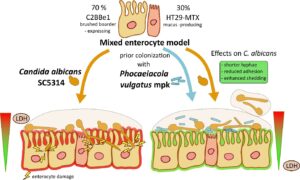
To test the effect of the bacteria, the study relied on mucus-producing and brushed-boarder-expressing cell lines that mimic the epithelial gut lining. These were colonized by Phocaeicola vulgatus before being infected by Candida albicans. The study shows that the host cells suffered less damage from the yeast cells and better maintained the integrity of the cell layer when the bacteria were present.
Two mechanisms contribute to this protective effect: Colonizing Phocaeicola vulgatus influence epithelial cells and increase the effective removal of the fungi from the surface through cell shedding. This results in more fungal cells in the supernatant, and fewer fungal cells in contact with the epithelial cells. Since fungal damage requires contact of Candida albicans with epithelial cells, increased shedding leads to less damage.
Second, living Phocaeicola vulgatus in direct contact with the fungus reduces adherence to epithelial cells. Microscopy even revealed reduced hyphal growth in the presence of bacteria. Both adhesion and hypha formation are virulence attributes and prerequisites for damaging epithelial cells. Interestingly, even dead Phocaeicola vulgatus cells convey some protection to epithelial cells.
Close relatives of Phocaeicola vulgatus, namely Phocaeicola dorei and Bacteroides thetaiotaomicron, can also protect epithelial cells through colonization, indicating a conserved trait within the family of Bacteroidacea. This prompts the potential to find a safe and effective probiotic strain among these bacteria.
Probiotic bacteria to attenuate Candida albicans virulence
As this study focused on the bacterial-fungal interaction within a cell culture model, the next step would be to test animal models. However, translatability remains a bottleneck in probiotic research and very few candidates eventually reach clinical studies.
In fact, there is not yet a clinically approved probiotic regimen to prevent or treat overgrowth by Candida albicans despite abundant fundamental research. With a global rise in antibiotic resistance, it is essential to increase efforts to develop alternative approaches to attenuate pathogenic virulence.
Since Phocaeicola vulgatus and their relatives are adapted to the gut and show promising anti-Candida albicans activity, they could be a Next-Generation Probiotic – aiding in the fight to reduce global suffering caused by fungal infections.
- Read the article “Phocaeicola vulgatus mpk colonization protects epithelial cells from Candida albicans infection” in the Thematic Issue “Infection biology of human-pathogenic fungi“ by Hammer et al. in microLife (2026).

Merle Hammer is a researcher at the Leibniz Institute for Natural Product Research and Infection Biology – Hans Knöll Institute- in Jena (GER) under the supervision of Prof. Dr. Ilse Jacobsen in the Department of Microbial Immunology. Merle Hammer completed her M. Sc. in Microbiology focusing on the interaction of beneficial bacteria and the pathogenic yeast Candida albicans. She continued her research on Candida albicans by studying how the intricate interaction of the host, the diet and the gut microbiota influence fungal colonization in the mouse gut. The work of her PhD thesis will contribute to the fundamental understanding necessary to develop preventive treatments to reduce Candida albicans colonization in vulnerable patients.
About this blog section
The section #FascinatingMicrobes for the #FEMSmicroBlog explains the science behind a paper and highlights the significance and broader context of a recent finding. One of the main goals is to share the fascinating spectrum of microbes across all fields of microbiology.
| Do you want to be a guest contributor? |
| The #FEMSmicroBlog welcomes external bloggers, writers and SciComm enthusiasts. Get in touch if you want to share your idea for a blog entry with us! |