



The Antarctic Ice Sheet is one of the most extreme environments on Earth. Here, surface snow and shallow ice have traditionally been considered barren environments with low microbial diversity. Yet, contrary to these beliefs, these environments contain diverse microbial assemblages that, in recent years, have become increasingly studied. That’s why the study “Microbial community structure in the firn associated with a ∼1000 km transect of the Eastern Antarctic Ice Sheet” in the Thematic Issue “Polar and Alpine Microbiology” in FEMS Microbiology Ecology investigated the microbial diversity of high-altitude firns from an Eastern Antarctic plateau. On this #FEMSmicroBlog, James Lawrence discusses the importance of understanding the local microbial diversity of subsurface cryosphere environments. #MicrobiologyIsEverywhere
Why we need to sample the Antarctic Continent
Microbial communities within the Antarctic Continent have not been the focus of much research so far. This is mainly due to its size and remoteness. Since the Antarctic Ice Sheet is also a huge but understudied freshwater reservoir, understanding the distribution of microorganisms is important for gaining insight into microbial ecology within the wider Antarctic cryosphere.
Furthermore, understanding the distribution of microbial organisms within the ice sheet will also help us better forecast the impacts of climate change, increased precipitation, and UV exposure.
That’s why the study “Microbial community structure in the firn associated with a ∼1000 km transect of the Eastern Antarctic Ice Sheet” in FEMS Microbiology Ecology explored how environmental factors influence the composition of microbial communities in firn cores of a high-altitude inland plateau of the Eastern Antarctic Ice Sheet.
Firn represents the transitional stage between deposited surface snow and deeper glacial ice. Since firn remains more dynamic than deeper glacial ice, the environmental conditions present here may influence microbial communities. To investigate how ‘firnification’ impacts community structure, the study collected and analysed four firn cores, across a 989 km transect and up to 27 m in depth, as part of a Norwegian-US scientific traverse across East Antarctica.
The main question was whether the microbial communities identified across this apparently uniform environment would vary between location and firn depth. They found evidence for both.
About the microbes within the Antarctic Ice
The researchers identified acteria from the orders Actinomycetales, Psudomonadales, and Bacillales across all cores at all depths. In comparison, in all cores at one depth, they identified Lactobacillales and Burkholderiales. Within one core, the microbial communities were also distinct. Hence, a microbial community detected at one depth differed from the one found only a few metres away within the same core.
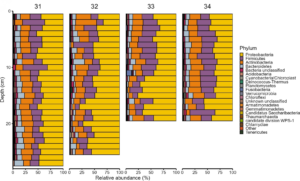
These spatial and structural heterogeneities of microbial communities may be influenced by small changes in these extreme environmental conditions. For example, ion concentrations differed between and within firn cores, which may explain the observed variation in microbial communities.
The study also found strong associations between local geochemical conditions and microbial community composition, even over very fine gradients. Of all the ions investigated, phosphate showed the biggest impact on microbial diversity.
These results suggest that differences in local chemical conditions, regardless of the overall concentration, may influence microbial distribution. However, these are correlations, rather than direct evidence that individual ions determine microbial community structure.
Arctic microbes going deep
The study demonstrates that the high-altitude inland plateau of the Eastern Antarctic Ice Sheet contains spatially heterogeneous and depth-dependent microbial communities. This finding is important when comparing microbial communities across Antarctic surface snow and shallow ice environments.
Investigating only a single firn core may not capture the broader variability throughout the Antarctic Ice Sheet. The results also demonstrate the value of considering the physical and chemical characteristics of firn for microbiological investigations.
- Read the article “Microbial community structure in the firn associated with a ∼1000 km transect of the Eastern Antarctic Ice Sheet” in the Thematic Issue “Polar and Alpine Microbiology” by Lawrence et al. in FEMS Microbiology Ecology (2026).
About the author
James Lawrence is a final year PhD candidate at Northumbria University, Newcastle, studying microbial diversity in polar environments. His work combines multi-omics approaches to investigating both microbial communities and potential adaptations of microorganisms in low biomass, extreme environments. His work spans multiple environments, ranging from Antarctic subglacial sediment to atmospheric samples, and covers both polar regions. He is also the incoming UKPN International Collaboration Officer.
About this blog section
The section #MicrobiologyIsEverywhere highlights the global relevance of microbiology. The section acknowledges that microbiology knows no borders, as well as the fact that microbiologists are everywhere and our FEMS network extends well beyond Europe. This blog entry type accepts contributions from excellent blogs translated into English. Regional stories with global relevance are welcomed. National or international events sponsored, organised or connected to FEMS are also covered.
| Do you want to be a guest contributor? |
| The #FEMSmicroBlog welcomes external bloggers, writers and SciComm enthusiasts. Get in touch if you want to share your idea for a blog entry with us! |