


Carbon is the backbone of life on Earth. Converting it into biomass is the job of primary producers—organisms that fix carbon from CO2 and transform it into organic molecules. Out of the seven known pathways organisms use to fix CO2, many modern primary producers employ the microbial acetyl-CoA pathway to fix carbon. The study “Protein folds and catalytic strategies at the origin of biological CO2 fixation” in the Thematic Issue “Advances in Microbial C1 Metabolism” in FEMS Microbiology Ecology takes a deep look into the enzymatic reactions of the acetyl-CoA pathway. In this #FEMSmicroBlog, Natalia Mrnjavac discusses how this could provide us with valuable insights into how life originated and evolved on Earth. #FascinatingMicrobes
CO2 fixation is the basis of all ecosystems on Earth
Photosynthetic organisms such as plants and most algae employ the Calvin-Benson-Bassham cycle to fix CO2 and transform it into biomass. All other carbon fixation pathways are used exclusively by microbes. Interestingly, these pathways differ in terms of enzymes, energetics, substrates, products, distribution in the tree of life, and evolution.
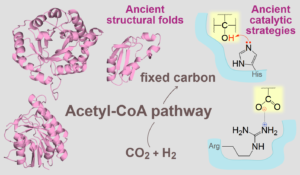
The reductive acetyl-CoA pathway, also known as the Wood-Ljungdahl pathway, is likely the most ancient one among known carbon fixation pathways. In fact, if early life relied on CO2 in the same way ecosystems do today, there is a good chance acetyl-CoA pathway may be one of the earliest metabolic pathways overall.
Why is this interesting? Ancient metabolic pathways can provide a window into early life. Essential functions and traits tend to be conserved over evolutionary time. In other words, the acetyl-CoA pathway and its enzymes could hold clues about the earliest steps of metabolic evolution.
Enzymes as molecular fossils provide a glimpse into early evolution
The study “Protein folds and catalytic strategies at the origin of biological CO2 fixation” in FEMS Microbiology Ecology analysed the reaction mechanisms to understand the strategies that enzymes of the acetyl-CoA pathway use to catalyse biochemical reactions.
Focusing first on the amino acids involved in the catalytic step, the authors found that enzymatic reactions mainly depend on cofactors and metal clusters. However, enzymes also heavily rely on catalysis by electrostatic interactions, general acid/base catalysis, metal ligation, activation, and steric effects. These strategies appear to have evolved early on to increase reaction rates.
Alongside catalytic strategies and the amino acids that mediate them, an enzyme’s three-dimensional structure is likely to be conserved over time, particularly the fold of its catalytic domain. Protein structure databases have greatly expanded in recent years thanks to tools such as AlphaFold, which have brought about a revolution in structure prediction. Structure-based tools and databases are a treasure trove of information with enormous potential to aid evolutionary studies.
Multiple enzymes of the acetyl-CoA pathway contain common folds, such as the Rossman fold, α/β-plaits, and TIM barrels, yet they carry out distinct functions. This suggests that they functionally diversified early in the history of life. These folds are versatile when it comes to binding organic and organometallic cofactors, which may be one of the reasons why they were favored in the early stages of metabolic evolution.
However, over half of the identified folds appear to have originated only once in the history of life and have not diversified since then. Yet, they confer key functions in the CO2 fixation metabolism.
The origin of enzymes—a key step in the emergence of life
Theories for the origin of life propose that life began from simple chemical reactions in water, relying on environmental CO2, molecular hydrogen, ammonia, hydrogen sulfide, and a phosphate source. These inorganic ingredients likely supplied the fundamental elements of life in a dynamic environment such as a hydrothermal vent.
Naturally occurring minerals and transition metals like iron and nickel could have acted as catalysts for the basic reactions. This primordial metabolism could have emerged before enzymes or the genetic code, driven by chemical energy and mineral catalysis.
Some transition metals can promote reactions resembling those in microbial metabolism, including a non-enzymatic variant of the acetyl-CoA pathway. The question, however, remains: how did such an abiotic reaction network transition into cells harboring a complex and finely tuned metabolism?
There are still many unknowns, but this study made one thing a bit clearer: the emergence of enzymes—enabled by the origin and functional diversification of ancient protein folds—was pivotal to the transition from prebiotic chemistry to life.
- Read the article “Protein folds and catalytic strategies at the origin of biological CO2 fixation” in the Thematic Issue “Advances in Microbial C1 Metabolism” by Mrnjavac in FEMS Microbiology Ecology (2026).

Natalia Mrnjavac is a PhD student at the Institute of Molecular Evolution at Heinrich Heine University in Düsseldorf, Germany, where she studies the origin of life and early microbial evolution in the group of Prof. William Martin. Her research focuses on the physiology and enzymatic make-up of the last universal common ancestor, as well as the divergence of the bacterial and archaeal domains. She is interested in applying structural data to early evolution research in order to improve sequence-based inferences and gain insight into the evolution of ancient proteins. Her broader interests include microbial physiology and ecology, particularly in extreme environments.
About this blog section
The section #FascinatingMicrobes for the #FEMSmicroBlog explains the science behind a paper and highlights the significance and broader context of a recent finding. One of the main goals is to share the fascinating spectrum of microbes across all fields of microbiology.
| Do you want to be a guest contributor? |
| The #FEMSmicroBlog welcomes external bloggers, writers and SciComm enthusiasts. Get in touch if you want to share your idea for a blog entry with us! |