



#FEMSmicroBlog: Building biomolecules from carbon dioxide and bicarbonate in unusual places
Primary producers use carbon dioxide and bicarbonate as their main carbon sources. To fix carbon, they rely on a variety of autotrophic pathways, with the Calvin-Benson-Bassham cycle (CBB) being well-studied. Just as organisms can tweak the CBB to the environmental context, the study “Evidence for ecological adaptation of reductive citric acid and reverse oxidative citric acid cycles based on a survey of genomes from autotrophic Bacteria” published in FEMS Microbes asked whether microorganisms would do the same with the reductive citric acid cycle (rTCA) and reverse oxidative citric acid cycle (roTCA). This study is one of the contributions to the Thematic Issue “Microbial Metabolism of Greenhouse Gases” which explores how microorganisms process and transform greenhouse gases. Kathleen Scott, Co-Editor-in-Chief of FEMS Microbes, explains for the #FEMSmicroBlog how environmental factors impact microbial metabolic steps. #FascinatingMicrobes
It all starts with microbial carbon fixation
Carbon-fixing microorganisms are responsible for various geochemical reactions, contributing to global primary productivity. Eight autotrophic pathways for carbon fixation have been described so far, with plants, algae, and many autotrophic bacteria relying on the Calvin-Benson-Bassham cycle (CBB).
Interestingly, these organisms adapt the CBB to a huge variety of contexts: in plants, it operates when water is scarce or when carbon dioxide supply is slow (e.g., in alkaline environments like the ocean, actively photosynthetic cyanobacterial mats, soda lakes) or erratic (e.g., hydrothermal vents).
Other organisms rely on the reductive citric acid (rTCA) or reverse oxidative citric acid (roTCA) cycles. These are based on many of the same biochemical steps as the oxidative citric acid cycle in mitochondria and other microorganisms. Yet, a few key enzymes vary and/or generate intermediates that push the reaction towards reductive carbon dioxide – and bicarbonate-fixation instead of oxidizing, carbon dioxide-production.
The rTCA and roTCA cycles operate wherever light and/or environmental electron donors are present: in sediments and soils, lake redoxclines, wastewater treatment facilities, acid mine drainage, deep-sea hydrothermal vents, terrestrial hot springs, and beyond. Although these cycles are found in numerous phyla within the domain Bacteria, it is not clear yet how these microorganisms adapt their metabolisms to specific environments.
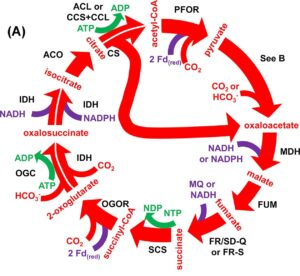
The study “Evidence for ecological adaptation of reductive citric acid and reverse oxidative citric acid cycles based on a survey of genomes from autotrophic Bacteria”, published in FEMS Microbes, shows that organisms from Pseudomonadota, Chlorobia, Campylobacterota, Nitrospirota, and Aquificota indeed adapt their rTCA and roTCA cycles to their environments.
Microbial reductive citric acid and reverse oxidative citric acid cycles are highly diverse
Microorganisms from a wide range of taxonomic clades use the rTCA and roTCA cycles, which is reflected in the many possible variations of these cycles apparent from genome data. Both cycles start with acetyl-CoA (2C), which the microorganism carboxylates four times to produce citrate (6C). Eventually it cleaves the molecule into oxaloacetate (4C) for biosynthesis and acetyl-CoA to continue the cycle.
Genomes from organisms using these cycles encode a huge variety of mechanisms for carboxylating 3C intermediates. Some of them come with high metabolic costs, such as ATP hydrolysis or coupling to cellular membrane potential.
This variety may provide advantages to the rTCA organisms in habitats with low light or low electron donor availability. It may also facilitate use of organic compounds as carbon sources in facultative autotrophs switching between the rTCA and roTCA.
Organisms using the rTCA and roTCA rely on a variety of cellular electron carriers to reduce metabolic intermediates. This likely forces the cycle towards a reductive direction.
Since two of these reductive steps rely on ferredoxin as an electron donor, many of these organisms are sensitive to oxygen. Interestingly, the oxygen sensitivity of other enzymes in these cycles, such as aconitase and fumarase, correlates with organismal oxygen sensitivity and may permit these cycles to operate in the presence of oxygen.
On the ecophysiology of microbial carbon fixation
In summary, this study broadened our understanding of the ecophysiology of carbon fixation by the rTCA and roTCA cycles and showed that taxonomic and environmental diversity drives diversity in these cycles.
These genome-based observations are begging for benchwork to uncover the conditions under which organisms adapt their rTCA or roTCA cycles to assist carbon fixation. Such research would broaden our understanding of the ecophysiology of carbon fixation by organisms using the rTCA and roTCA cycles and provide insights for carbon fixation in industrial contexts to synthesize compounds of industrial relevance.
- Read the review “Evidence for ecological adaptation of reductive citric acid and reverse oxidative citric acid cycles based on a survey of genomes from autotrophic Bacteria” in the Thematic Issue “Microbial Metabolism of Greenhouse Gases” by Scott et al. in FEMS Microbes (2026).
 Kathleen Scott is a microbial physiologist whose research focuses on dissolved inorganic carbon metabolism, mostly by autotrophic bacteria. She enjoys incorporating ongoing research projects into Classroom Undergraduate Research Experiences (CUREs) to give students the chance to see what “real science” is like. Beyond the classroom and lab, she enjoys playing the bagpipes with a band, and hiking with her wife.
About this blog section
The section #FascinatingMicrobes for the #FEMSmicroBlog explains the science behind a paper and highlights the significance and broader context of a recent finding. One of the main goals is to share the fascinating spectrum of microbes across all fields of microbiology.
| Do you want to be a guest contributor? |
| The #FEMSmicroBlog welcomes external bloggers, writers and SciComm enthusiasts. Get in touch if you want to share your idea for a blog entry with us! |