



Bacteria can move efficiently thanks to one of nature’s most sophisticated molecular machines: the flagellum. This rotary motor propels them through oceans, soils, and even our bodies. For decades, our understanding of bacterial flagella has largely come from model organisms such as Escherichia coli and Salmonella enterica. Yet, recent advances in cryo-electron tomography are revealing that bacterial flagellar motors are far more diverse and complex than they were previously imagined. The review “The Ancient E-ring in Bacterial Flagellar Motors” in FEMS Microbiology Reviews dives into a long-overlooked and newly characterized component of this molecular motor: the mysterious “E-ring”. #FascinatingMicrobes
Defining the long-standing “Extra ring” component
The E-ring was first observed in 1979 in Caulobacter crescentus using electron microscopy. Because it appeared as a thin, extra disk-like shadow surrounding the upper part of the rotor that was absent in Escherichia coli, it was named the “Extra ring”. For over four decades, its protein composition remained a mystery, and it was often dismissed as an obscure, species-specific component.
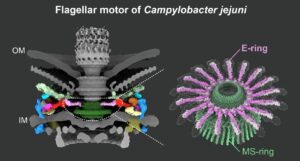
Parallel genetic studies across various bacteria independently identified several motility-related proteins—including MotE in α-proteobacteria, FlbB in Spirochaetota, and FlgY in Campylobacterota. But their connection with the E-ring was only recently established: high-resolution cryo-electron tomography revealed FlgY as the ring-forming structural component.
Based on their conserved structural fold and identical positions within the flagellar motor, MotE, FlgY, and FlbB were found to be evolutionarily and functionally related. Multiple dimers of MotE/FlbB/FlgY homologs assemble into a conserved “ring-and-spoke” structure surrounding the central membrane-supramembrane (MS) ring of the motor, a key rotating structure at the heart of the flagellum.
One conserved structure with diverse functions
The review “The Ancient E-ring in Bacterial Flagellar Motors” in FEMS Microbiology Reviews discusses what makes the E-ring fascinating and remarkable: its functional versatility across different bacteria.
In free-living environmental α-proteobacteria Sinorhizobium meliloti and Cereibacter sphaeroides, E-ring homologs (named MotE) interact with stator-associated scaffold proteins, including MotC and MotK. Loss of MotE leads to MotC degradation, disrupting stator assembly, and rendering the bacteria non-motile.
In the Lyme disease spirochete Borrelia burgdorferi, the E-ring protein FlbB is required for assembling the large collar structure surrounding the motor core. In the foodborne pathogens Campylobacter jejuni and Helicobacter pylori, the E-ring protein FlgY instead forms a spoke-like scaffold around the motor. Even though similar, these play dramatic but distinct roles.
Without the E-protein FlbB, Borrelia burgdorferi loses its iconic wave-like shape, fails to form its protective motor “collar”, and becomes entirely paralyzed. In Helicobacter pylori, loss of FlgY destabilizes multiple motor structures and severely reduces motility. In contrast, Campylobacter jejuni mutants lacking FlgY can still swim, but exhibit defects in host interaction and invasion.
These variations stem from distinct structural adaptations. While FlbB is a transmembrane protein, FlgY features a secretion signal peptide and lacks a transmembrane region. Consequently, FlgY does not insert into the inner membrane but instead interacts with adjacent regions that extend toward the stator units. Hence, the phenotypic differences are likely due to E-ring symmetry relative to the stators, and another medial ring of unknown composition in Helicobacter pylori.
The ancient E-ring from the last bacterial common ancestor
Because E-ring proteins are highly divergent in sequence, their distribution across the bacterial domain remained largely overlooked. Recent advances in structural biology and AlphaFold-based protein prediction have shattered these barriers, revealing that despite their sequence divergence, these proteins all share a highly conserved C-terminal armadillo repeat motif (ARM)-like fold.
Combining comparative genomics with structural prediction further revealed that nearly two-thirds of flagellated bacterial species possess E-ring proteins. Intriguingly, the major exceptions are β– and γ-proteobacteria: lineages containing classic model organisms such as Escherichia coli and Salmonella enterica.
This distribution pattern suggests that the E-ring is ancient and may have already existed in the last bacterial common ancestor (LBCA). Rather than representing the prototype of the ancestral motor, the E. coli motor may represent a simplified evolutionary lineage that lost this ring over time.
This discovery profoundly shifts our fundamental understanding of how these intricate biological nanomachines first evolved. Our review further highlights how studies beyond classic model organisms are reshaping current views of flagellar structure, diversity, and evolution across the bacterial domain.
- Read the review “The ancient E-ring in bacterial flagellar motors” by Zhu et al. in FEMS Microbiology Reviews (2026).

Siqi Zhu is an associate professor at the South China Sea Institute of Oceanology, Chinese Academy of Sciences (CAS), where she also received her PhD in Marine Biology in 2023. Her research focuses on microbial evolution and functional genomics, particularly the mechanisms underlying microbe–environment interactions and bacterial pathogenicity. Combining comparative genomics, evolutionary analysis, and structural biology, her work explores the functional mechanism and evolutionary strategies by which bacterial flagellar and chemotaxis systems adapt to diverse ecological niches and facilitate host infection.
About this blog section
The section #FascinatingMicrobes for the #FEMSmicroBlog explains the science behind a paper and highlights the significance and broader context of a recent finding. One of the main goals is to share the fascinating spectrum of microbes across all fields of microbiology.
| Do you want to be a guest contributor? |
| The #FEMSmicroBlog welcomes external bloggers, writers and SciComm enthusiasts. Get in touch if you want to share your idea for a blog entry with us! |