



Just like all other organisms, plants are not alone in responding to changes in their environment. Complex microbial communities inhabit the rhizosphere, the area of soil surrounding plant roots. Here, soil microbes interact with each other and with the plant, contributing to the plant’s dynamic adaptation to the environment. The study “Successive cultivation under drought selects for specific microbiome members in the wheat rhizosphere” in the Thematic Issue “Ecology of Soil Microorganisms” in FEMS Microbiology Ecology explores how these communities assemble and change over time under repeated environmental stimuli. Adele Pioppi explains in this #FEMSmicroBlog. #FascinatingMicrobes
About plants and their microbes
Plant-associated microbial communities provide integral support to the health and resilience of their host. But just as plants need to adapt to different environmental conditions, so do their associated microbes.
Indeed, environmental stressors, such as drought, can shift the rhizosphere’s microbial composition. Plant microbiome research has increasingly focused on understanding the ecological processes that structure these communities, and on how they adapt in conjunction with the plant to respond to external conditions.
Understanding this adaptation can make a difference towards optimizing the resilience of crops to changing environmental stimuli. This is why the study “Successive cultivation under drought selects for specific microbiome members in the wheat rhizosphere” in FEMS Microbiology Ecology investigated how rhizosphere microbiomes develop under repeated drought exposure across multiple wheat growth cycles.
Soil microbes change with their plants
The experimental design relied on repeated microbiome transfer. For this, wheat plants were cultivated under either drought or watered conditions. After each cycle, the rhizosphere microbiomes of selected plants were transferred to the next generation of seedlings.
By maintaining the independent replicate “lineages” throughout the experiment, it became possible to examine the effect of repeated microbiome selection on community composition. This further helped us understand whether replicate communities converged toward similar states or diverged over time.
The study also explored how the composition of the starting inoculum influenced later microbiome assembly. For this, the researchers inoculated plants with or without an 86-strain wheat-isolate library and compared microbial composition.
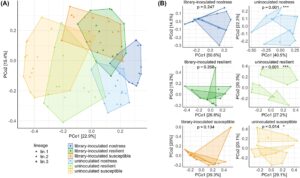
As expected, repeated drought exposure consistently shaped bacterial communities in the wheat rhizosphere. Drought and watered lineages developed distinct microbial communities across cultivation cycles.
Additionally, selecting the microbiomes of drought-resilient plants resulted in different community traits from selecting the microbiomes of drought-susceptible plants.
Interestingly, replicate lineages behaved differently depending on starting conditions. Lineages inoculated with the bacterial library tended to develop into relatively similar microbiomes under the same treatment conditions. Uninoculated lineages displayed greater divergence.
What drives soil microbial shifts?
These results fit into a broader discussion about the processes guiding community assembly of plant microbiomes. This becomes especially important for increasingly frequent stress conditions impacting agricultural fields.
The findings indicate that repeated drought exposure consistently influenced community composition. At the same time, the composition of the starting community shaped the trajectories of replicate lineages.
The experiment addressed another common assumption in plant microbiome research: that taxa enriched under stress conditions are necessarily beneficial for the host. Certain genera, including Stenotrophomonas and Rahnella, became enriched during selection, yet representative strains did not improve drought resilience when tested individually in wheat.
This observation reinforces a growing recognition in the field that microbial persistence under stress conditions may reflect adaptation to the soil environment, interactions within the microbial community, responses to altered root exudation, or combinations of these factors. However, rhizosphere function is likely shaped by complex community interactions rather than by the action of single strains.
This work is part of the INTERACT project within the Collaborative Crop Resilience Program (CCRP), which aims to better understand the ecological processes underlying plant–microbiome interactions, particularly in wheat. Understanding community assembly over time may help clarify how plant-associated microbial communities respond to environmental pressures and which microorganisms may have potential as plant growth-promoters.
- Read the article “Successive cultivation under drought selects for specific microbiome members in the wheat rhizosphere” in the Thematic Issue “Ecology of Soil Microorganisms” by Pioppi et al. in FEMS Microbiology Ecology (2026).

Adele Pioppi is a postdoctoral researcher at the Technical University of Denmark (DTU), working at Leiden University in the Netherlands in the group of Prof. Dr. Ákos T. Kovács. She completed her PhD in Plant Microbiome Ecology, supported by the INTERACT Project of the Collaborative Crop Resilience Program. Her research focused on the compositional shifts within and across rhizosphere communities exposed to various abiotic external factors, particularly drought and high salinity, as well as the implications of plant host genetic divergence for the plant microbiome.
About this blog section
The section #FascinatingMicrobes for the #FEMSmicroBlog explains the science behind a paper and highlights the significance and broader context of a recent finding. One of the main goals is to share the fascinating spectrum of microbes across all fields of microbiology.
| Do you want to be a guest contributor? |
| The #FEMSmicroBlog welcomes external bloggers, writers and SciComm enthusiasts. Get in touch if you want to share your idea for a blog entry with us! |