


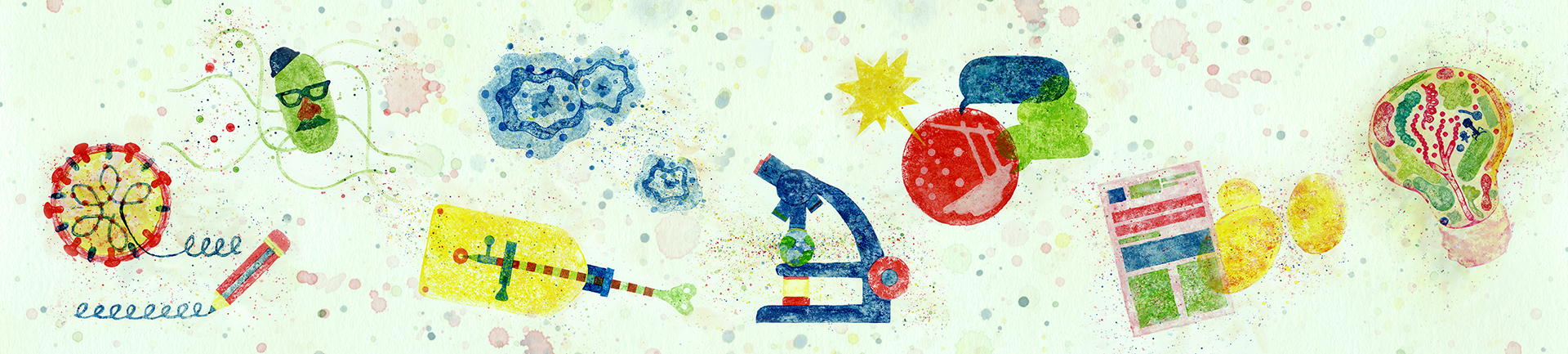
The environmental conditions of early Earth closely resembled those of early Mars. Since extremely thermoacidophilic microorganisms represent potential life forms on early Earth, they are excellent candidates for astrobiological research. In particular, the production of isoprenoid quinones provides clues about the environmental conditions in which extremophiles, notably those of the order Sulfolobales, reside. The study “Assessing cell survival and biosignature preservation of the extremely thermoacidophilic archaeon Acidianus manzaensis after exposure to Mars-like conditions” in the Thematic Issue “Astrobiology and Extremophiles” investigated the survivability of one extremophile to better understand how we might be able to detect life on Mars. Sebastian Gfellner explains on the #FEMSmicroBlog. #FascinatingMicrobes
Can you summarise the significance of your paper for microbiologists outside your field?
The archaeon Acidianus manzaensis from the order Sulfolobales, isolated from a hot fumarole, thrives at high temperatures and low pH, and tolerates high concentrations of heavy metals. As these conditions are similar to those of the geochemically active Martian past, it serves as an excellent organism to investigate survivability under Mars-like conditions.
For this, we exposed Acidianus manzaensis to one month of desiccation and two weeks in a Mars Simulation Chamber. We tested its survivability and investigated specific respiratory electron carriers, namely thiophene-bearing quinones. These are biosignatures for life detection because their basic moieties have been found on Mars.
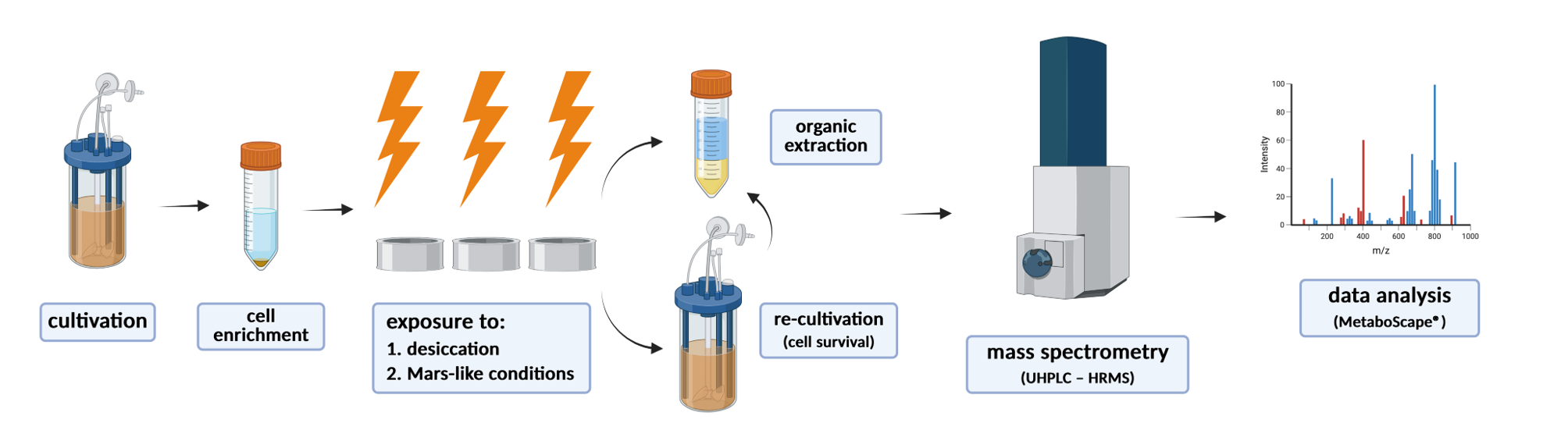
Since Acidianus manzaensis survived these extreme conditions, we can consider it an astrobiological model organism. Furthermore, we propose biologically relevant structural specifications for thiophene-bearing quinones.
Why are your results important for society?
We worked with a microorganism that is of great interest for bioleaching and biomining. Let’s imagine a scenario in which we want to build a Martian settlement, for which we would need to mine mineral ores on the Martian surface. One could consider using microorganisms for this process instead of toxic chemicals for mineral leaching.
First, this would decrease transport costs, as the weight of microorganisms naturally increases during growth, while massive amounts of chemicals would otherwise need to be transported from Earth to Mars. Second, it provides the possibility to treat another planet sustainably and ecologically from the very beginning.
But for this to happen, we need to understand how microorganisms withstand these extreme environments, and we need the right tools. Techniques designed for space research can be applied on Earth, ranging from biomining to CO2 capture and self-sustaining closed-loop systems.
Additionally, extremophilic microorganisms also produce molecules that are stable over geological timescales. Studying them in more detail can provide us with a better understanding of biosignatures, which could ultimately answer one of the most fundamental questions: Are we alone in the universe?
What is a surprising finding you stumbled upon while doing your research?
Extremophiles always surprise me as they constantly push the boundaries of life as we know it. Working with an organism that could potentially withstand a two-week journey on the Martian surface opens a follow-up question: What is its limit and how would it react to cosmic radiation? Thus, I would be very excited for follow-up experiments; I already have some in mind.
Why did you choose to dive into the topic of this paper? What fascinates you about the topic?
Humans have always been looking at the stars, asking ourselves whether we are alone in the universe. Being part of this scientific journey and unravelling one small piece of this big question is a dream I have cherished since first looking at the stars and asking this very question myself.
I am fascinated by detecting life on other planetary bodies, living in times when an answer to this question is becoming increasingly approachable. In addition, I love the synergistic effect of space research; there is always one result or outcome that can be applied on Earth to help solve one of our problems.
You decided to opt for the Transparent Peer Review route offered by FEMS Microbes. What motivated you to do so, and what are the benefits in your opinion?
Being an advocate for open science, I see the transparent peer review process as a guarantee for visibility of the scientific process and the objectivity of science. Openly stating who reviewed the paper while being thankful for constructive comments in this process that improved the overall quality of the paper also acknowledges the voluntary process.
Scientists review papers on top of their everyday workload, which is why I value this contribution. Without this process, science, as we know it, would not be feasible. It also showcases the scientific dialog necessary for achieving certain standards and may contribute to greater trust in science in society.
- Read the article “Assessing cell survival and biosignature preservation of the extremely thermoacidophilic archaeon Acidianus manzaensis after exposure to Mars-like conditions” in the Thematic Issue “Astrobiology and Extremophiles” by Gfellner et al. in FEMS Microbes (2026).
Sebastian Gfellner received his doctorate from the Exobiology Group at the CNRS – Center for Molecular Biophysics and the University of Orléans, France. His scientific journey began in geosciences and continued in astrobiology. His research focuses on extremophile microorganisms, their survivability under extreme conditions, and the analysis of their biosignatures. He is particularly interested in the search for traces of microbial life on other planets, especially Mars. Through collaboration with the artist Anna Steward, he added a transdisciplinary narrative to his research, bridging the worlds of art and science.
About this blog section
The section #FascinatingMicrobes for the #FEMSmicroBlog explains the science behind a paper and highlights the significance and broader context of a recent finding. One of the main goals is to share the fascinating spectrum of microbes across all fields of microbiology.
| Do you want to be a guest contributor? |
| The #FEMSmicroBlog welcomes external bloggers, writers and SciComm enthusiasts. Get in touch if you want to share your idea for a blog entry with us! |