



From food additives to biodegradable plastics, organic acids are everywhere in modern life. One of them, L-malic acid, is widely used in the food and beverage industry, giving products a characteristic tart taste. Despite its growing industrial relevance, most malic acid is still produced either from fossil resources or from sugar-based microbial fermentation, which competes with food production. That’s why the study “Optimization and scale up of L-malic acid production from methanol by the methylotrophic yeast Ogataea polymorpha” in FEMS Yeast Research aimed to produce malic acid from a carbon source derived from CO₂. Alessandra Mauri explains on this #FEMSmicroBlog how this process was improved step-by-step. #MicrobiologyIsEverywhere
Malic acid from methanol – a green alternative
Beyond food, malic acid is an important building block for biodegradable materials and bio-based chemicals. But producing malic acid still depends on fossil resources or, when performed microbiologically, on sugar-based feedstocks. Both routes come with caveats, generating emissions and competing with food supply.
The study “Optimization and scale up of L-malic acid production from methanol by the methylotrophic yeast Ogataea polymorpha” published in FEMS Yeast Research explored an alternative. Unlike conventional yeasts, methylotrophic yeasts can grow on methanol as the sole carbon and energy source.
Methanol is particularly attractive as a feedstock because it can be generated from captured CO₂ using renewable energy. Compared with gaseous one-carbon substrates, methanol is also easier to transport, store, and integrate into existing industrial infrastructure.
However, when yeast metabolizes methanol, it generates toxic intermediates such as formaldehyde and hydrogen peroxide. This becomes a strong physiological burden on the cell and makes stable production processes difficult.
Previously, the group engineered Ogataea polymorpha to produce malic acid from methanol by introducing a heterologous reductive TCA pathway. While promising, the process still suffered from low yields and unstable cultivation conditions.
Rendering yeast metabolism
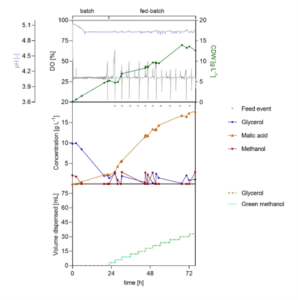
In this new study, the authors focused on solving the bioprocessing bottlenecks. They developed and scaled up a two-phase fermentation strategy: the yeast first grows on glycerol before switching to methanol-based production.
They then implemented automated feeding systems that continuously adjusted methanol supply according to the metabolic activity of the cells. Among the tested approaches, a dissolved oxygen-based feeding strategy performed best since it dynamically matched methanol availability with the cells’ actual metabolic capacity. This prevented methanol from accumulating and maintained more stable production conditions.
It was particularly interesting to find out how important it was to co-feed glycerol together with methanol. Before, glycerol seemed to play only a minor role as a carbon source for malic acid synthesis.
This optimized mixed-feed strategy dramatically improved process performance and yields, reaching malic acid titres of up to 26 g L-1. Importantly, they also demonstrated successful fermentation using CO₂-derived methanol, highlighting the feasibility of integrating microbial production into a future circular carbon economy.
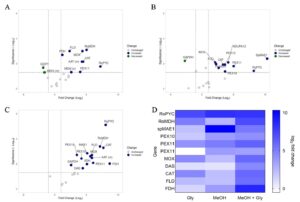
To understand the synergistic effect of glycerol and methanol on the yeast’s metabolism, they further analysed the expression of genes involved in methanol metabolism, peroxisome biogenesis, and cellular redox balancing. Methanol strongly induces the methanol utilization pathway, while glycerol stabilizes the energetic and redox state of the cells. Together, they create a more robust metabolic environment that supports sustained production.
This work contributes to a broader effort in industrial biotechnology: replacing fossil-based chemical production with microbial cell factories powered by renewable carbon sources. While methanol-based bioprocesses are still at an early stage, methylotrophic yeasts such as Ogataea polymorpha are emerging as promising platforms for sustainable manufacturing.
The transition toward a circular bioeconomy will require not only new engineered microorganisms, but also smarter bioprocess strategies that account for cellular physiology, metabolic stress, and process control. As industries search for sustainable ways to produce chemicals without relying on fossil feedstocks or food crops, even a simple yeast growing on methanol may become part of the solution.
- Read the research article “Optimization and scale up of L-malic acid production from methanol by the methylotrophic yeast Ogataea polymorpha” by Mauri et al. in FEMS Yeast Research (2026).

Alessandra Mauri is an Italian PhD candidate in Applied Microbiology at RWTH Aachen (Germany). She holds a Bachelor’s degree in Biotechnology, and a Master’s degree in Industrial and Molecular Biotechnology. During her PhD, she has worked with microorganisms adapted to C1 substrates, such as methane-oxidizing bacteria and methylotrophic yeasts, with a focus on developing sustainable solutions for a circular bioeconomy.
About this blog section
The section #MicrobiologyIsEverywhere highlights the global relevance of microbiology. The section acknowledges that microbiology knows no borders, as well as the fact that microbiologists are everywhere and our FEMS network extends well beyond Europe. This blog entry type accepts contributions from excellent blogs translated into English. Regional stories with global relevance are welcomed. National or international events sponsored, organised or connected to FEMS are also covered.
| Do you want to be a guest contributor? |
| The #FEMSmicroBlog welcomes external bloggers, writers and SciComm enthusiasts. Get in touch if you want to share your idea for a blog entry with us! |