


Plastic materials have transformed our daily lives, including farming. But plastic residues impact our soils, even though we do not fully understand how. Soil microbes are a key component in understanding the impacts of microplastics on soil processes and plant health. This is why the study “Conventional and biodegradable microplastics elicit contrasting taxon-level responses in rhizosphere microbiomes of maize and strawberry” in the Thematic Issue “ Microbial Ecotoxicology of Contaminants of Emerging Concern” in FEMS Microbiology Ecology focuses on these impacts. Aileen Jung explains how different plastic types affect soil microbiomes and crop performance.#FascinatingMicrobes
Microplastics do not act alone
The fate of microplastics in soils depends not only on plastic-related features but also on characteristics of the surrounding soil and plants. Biodegradable plastics have been intensively promoted as promising alternatives to conventional plastics.
Given their biodegradability, carbon from bioplastics is more accessible and available to microbes. In addition, such new carbon sources can stimulate the acquisition of other essential soil nutrients. Consequently, biodegradable plastics are expected to affect carbon and nutrient cycling more directly than conventional, more persistent plastics. Crops structure the surrounding soil microbiota by recruiting beneficial microbes and stimulating their activity. In turn, soil microbes provide resources that promote plant health and growth.
Closer to plant roots, in the rhizosphere, these interactions intensify. Yet, it is unclear whether microbial communities in the rhizosphere respond to microplastics differently than communities in soil farther away from the roots, or those surrounding other crop species.
The study “Conventional and biodegradable microplastics elicit contrasting taxon-level responses in rhizosphere microbiomes of maize and strawberry” in FEMS Microbiology Ecology addressed whether different microplastic types alter soil microbial community composition in contrasting crops and at varying distances from the plant roots.
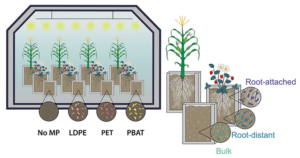
To investigate the response of rhizosphere microbiota, maize and strawberries were selected as host plants because they are more likely to be exposed to plastic contamination in commercial farming. Plants were grown in soils treated with a conventional or biodegradable polymer.
The study then relied on community profiling by sequencing both prokaryotic DNA and rRNA. Overall, 84% of the observed plastic-derived changes in abundance were identified only in rRNA profiles, highlighting the value of complementing DNA profiles with RNA-based approaches.
Microplastic impacts crop growth, soil nutrients, and microbiomes
All tested microplastics boosted strawberry growth while lowering nitrate levels in the soil. Maize microcosms showed no such effect, suggesting that microplastics may have promoted nutrient uptake in strawberry soils.
Although distinct plastic types yielded the same outcome, the underlying driver may differ: conventional plastics may have altered soil properties, such as porosity. Biodegradable plastics, however, seem to promote the release of plant-available soil nutrients during their degradation.
The plant species and distance from plant roots were the main factors shaping the soil microbiomes. Microplastics emerged as an additional factor influencing the communities.
Certain taxonomic groups seemed particularly responsive to plastic additions, either showing an increased or decreased abundance in plastic-treated soils relative to unamended controls. In general, plastic-related changes in taxon abundance were consistent across all soil compartments and thus independent of the distance to the plant root.
Yet, biodegradable and conventional polymers affected community members differently, likely due to their distinct intrinsic polymer properties and microbial accessibility. Conventional microplastics affected a broader range of community members. For example, the abundance of typical heterotrophs, such as members of Gemmataceae, Solimonadaceae, Solirubrobacteraceae, and Oxalobacteraceae, increased. On the other hand, taxa such as Sphingomonas spp., Rhodanobacter spp., Pseudomonas spp., and members of Caulobacteraceae decreased.
In contrast, soils treated with biodegradable plastics specifically stimulated Cupriavidus spp. and members of the Saccharimonadales. These taxa may be involved in degradation processes or benefit from the released carbon.
The impact of microplastics on agricultural soils through the microbiome
As conventional and biodegradable plastics are widely used in agricultural practices, it is essential to understand their impact on soil health. This study demonstrates that rhizosphere microbial communities are shaped by both plant species and microplastics, with direct consequences for plant growth.
- Read the article “Successive cultivation under drought selects for specific microbiome members in the wheat rhizosphere” in the Thematic Issue “ Microbial Ecotoxicology of Contaminants of Emerging Concern” by Jung et al. in FEMS Microbiology Ecology (2026).
Aileen Jung focused her doctoral studies on the impacts of microplastics on soil and rhizosphere microbial communities and their potential to degrade plastic polymers in the research group of Dr. Tillmann Lueders at the University of Bayreuth (Germany) within the Collaborative Research Center 1357 Microplastics. Her broader research interest centers on the ecology and ecophysiology of microbial communities that transform biogenic and anthropogenic organic substrates. She is currently investigating how specific microbial populations contribute to the decomposition of microbial necromass in Dr. Emil Ruff’s research group at the Marine Biological Laboratory (Woods Hole, USA).
About this blog section
The section #FascinatingMicrobes for the #FEMSmicroBlog explains the science behind a paper and highlights the significance and broader context of a recent finding. One of the main goals is to share the fascinating spectrum of microbes across all fields of microbiology.
| Do you want to be a guest contributor? |
| The #FEMSmicroBlog welcomes external bloggers, writers and SciComm enthusiasts. Get in touch if you want to share your idea for a blog entry with us! |