
Next July, microbiologists from around the world will come together in Ljubljana to explore where the field is heading. Now, you can help shape what they discover there.
Abstract submissions are officially open for FEMS MICRO Ljubljana 2027: Congress & Exhibition, taking place from 5–8 July 2027 in Ljubljana, Slovenia. Under the theme Growing microbial futures, the Congress & Exhibition will bring together new discoveries, emerging questions, and different perspectives from across microbiology. By submitting an abstract, you can put your own research at the heart of those conversations.
Share what you are discovering
Whether you are uncovering new findings, testing a different approach, or exploring a question that deserves greater attention, FEMS MICRO 2027 offers an international platform to introduce your work and hear how others are approaching similar challenges. Not every piece of research needs to be presented in the same way. FEMS MICRO 2027 gives you several ways to become part of the programme:
- Start a conversation with a poster display, giving attendees the chance to explore your research with you in more depth.
- Put the spotlight on a key idea with a flash talk, combining a five-minute presentation with a poster.
- Take the stage with a session talk, sharing your research in ten minutes before opening the discussion to questions.
Submit your Abstract submission proposal by 15 December 2026 at 23:59 CET.
There’s also still time to propose an interactive session for FEMS MICRO 2027. Designed around active participation, these 60-minute sessions can take the form of workshops, roundtable discussions, interactive panels, or fishbowls. Don’t miss the chance to submit your Interactive Session proposal by 30 September 23:59 CEST.
A first look at what is in store
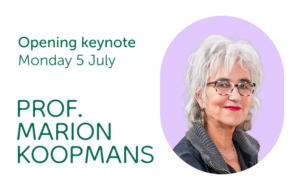
The scientific programme for Ljubljana is beginning to come together, with four keynote speakers confirmed. Professor Marion Koopmans will open FEMS MICRO 2027, drawing on her work in virology, emerging infectious diseases, and pandemic preparedness. She will be joined by Professor César de la Fuente, whose research combines artificial intelligence and experimental technologies across microbiology, computation, engineering, and chemistry, and Professor Liane G. Benning, whose work explores the interfacial reactions that drive and regulate biogeochemical processes. Professor John Cryan will deliver the closing keynote, drawing on his research into the microbiome-gut-brain axis and its influence on stress, mental health, immune function, and brain development.



The programme also features additional speakers selected by the FEMS Journals, bringing further breadth of expertise to FEMS MICRO 2027. Dr Gianni Liti studies natural variation through yeast genetics and genomics, while Dr Lígia Coelho explores microbial life in extreme environments and the search for life beyond Earth. Professor Tracy Palmer, recently appointed Co-Editor-in-Chief of microLife, focuses on bacterial protein secretion and microbial pathogenesis. Professor Tillmann Lueders investigates environmental microbiomes and the roles microorganisms play in biogeochemical processes and ecosystem function.
Could extra funding help get you there?
Applications for FEMS MICRO Attendance Grants are also now open, helping eligible early-career researchers take part in FEMS MICRO Ljubljana 2027. Researchers can apply as part of the abstract submission process, with successful applicants receiving support towards attending the Congress & Exhibition. Funding linked to selected FEMS awards is also available. Explore the full range of options to find the route that applies to you.
Add your work to Growing microbial futures
The programme for FEMS MICRO Ljubljana 2027 will be shaped not only around invited speakers, but around the research, questions, and perspectives contributed by the microbiology community. This is your opportunity to add yours.
Submit your abstract by 15 December 2026 (23:59 CET) and join us in Ljubljana.