


Understanding why some microorganisms can survive conditions too extreme for humans may start with microbiology. But it does not necessarily end there. Instead, extremophile microbiology draws from multiple disciplines including molecular biology, biochemistry, geochemistry, organic chemistry, planetary science, and evolution. In the article “Life Resists Chemistry Not Conditions”, part of the Thematic Issue “Astrobiology and Extremophiles” in FEMS Microbes, Adrienne Kish combines a detailed mechanistic view with a broad overview encompassing the entire range of extremes. The common ground is found in the chemistry of cellular life. #FascinatingMicrobes
Life resists chemistry, not conditions
Simple ideas are easy to overlook in the scientific world. This is the challenge of interdisciplinarity; to bring forward the underlying principles of each discipline in a manner that all can understand.
Applying this to the field of extreme microbiology, one simple principle provides a common point for interdisciplinary investigations of the limits of life: Life resists chemistry, not conditions.
While the idea itself has existed as an unspoken assumption in microbiology, it is time to bring that idea into the open. It is a simple but powerful concept in an era where rapid technological and scientific progress, particularly in life sciences, is converging with interdisciplinary scientific interests.
Scientists studying extreme microbes often investigate questions as diverse as climate change, biodiversity, planetary geochemistry, and exoplanet habitability. By basing the discussion on basic chemistry, we can share a common understanding of microbial life. It provides a basis for evaluating whether there are limits to life, what those limits are, and why such limits exist.
A microbial cell is essentially a fatty sac (lipids) holding a chemical soup of proteins and DNA, and RNA (nucleic acids) together in a solvent (water). Each of these cellular components can be impacted by different physicochemical stressors such as pH and temperature extremes, salinity, desiccation, high pressure, or solar radiation.
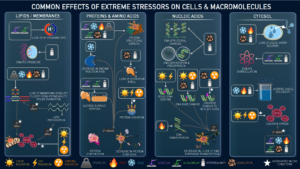
Some stressors can produce the same types of chemical damage. Cells with adaptation mechanisms for certain types of damage can survive those stressors that produce those types of damage.
Introducing a new framework for extreme microbiology
The article “Life Resists Chemistry Not Conditions” in FEMS Microbes provides a reference for biologists and non-biologists alike to build future interdisciplinary scientific interactions. It provides a teaching reference for the ensemble of life in extreme environments at the molecular scale.
Previously, focusing on the conditions themselves was usually intended only to be descriptive. However, molecular-level techniques have advanced and are helping to uncover the underlying chemistry of cells. That’s why continuing to categorize life by environmental conditions restricts thinking about the true limits of life.
Conditions in the native environment of microorganisms are not necessarily indicative of which physicochemical stressors microbes can survive, let alone why they can survive them.
The idea of the new framework is to focus on the chemical effects of the stressors, which allows us to more accurately assess the limits of microbial survival. It also helps to explain phenomena for which standard evolutionary frameworks cannot be directly applied.
For example, several extremophiles are inherently resistant to radiation. Yet several of these are naturally not even exposed to radiation.
Seeing common links at the molecular level between life forms that survive and thrive in seemingly divergent environments helps us understand how life exists on Earth and its potential to exist on other planetary bodies. This subtle shift in perspective can also be applied to the development of microbial and molecular detection technologies, planetary protection policy strategies, and even industrial sterilization or decontamination processes.
Such simple ideas go against the twin modern scientific tendencies to ever-increasing complexity and hyper-specialization. In this way, patterns emerge between disparate elements. Science so simple it seems obvious. Life resists chemistry, not conditions.
- Read the review “Life Resists Chemistry Not Conditions” in the Thematic Issue “Astrobiology and Extremophiles“ by Kish in FEMS Microbes (2026).

Adrienne Kish is an extremophile microbiologists and Associated Professor at the Muséum National d’Histoire Naturelle in Paris, France. She takes a diverse approach to research, studying microbes from all different types of extreme environments right down to their component molecules to try to understand what makes them work. Her work starts with the only place we know life exists, on Earth, and extends to the potential life elsewhere in the universe. Her greatest joys in science come from finding the unexpected connections between ideas, and from creating spaces for others to forge new scientific connections. She has never stopped dreaming.
About this blog section
The section #FascinatingMicrobes for the #FEMSmicroBlog explains the science behind a paper and highlights the significance and broader context of a recent finding. One of the main goals is to share the fascinating spectrum of microbes across all fields of microbiology.
| Do you want to be a guest contributor? |
| The #FEMSmicroBlog welcomes external bloggers, writers and SciComm enthusiasts. Get in touch if you want to share your idea for a blog entry with us! |