


Bacteriophages, or phages, are the most abundant biological entities on earth. Yet this enormous viral reservoir remains underexplored. Isolating and characterizing novel phages, especially from non-model hosts, would not only deepen our fundamental understanding of phage biology, genetic diversity, and virus-host interactions but could also find new therapeutic approaches. That’s why the article “A satellite in the phage universe: Isolation and characterization of six novel Streptomyces phages AndoPrime, Ando, Arkania, Jaresh, Tatooine, and Galidraan” in FEMS Microbes aimed to uncover viral dark matter in a non-model bacterial host. For World Phage Day, Moses Kabuu explores recent developments in phage research and how these tiny predators can help us solve some of the most pressing challenges in infectious diseases while advancing biology and biotechnology. #MicrobiologyEvents
Beyond bacterial predators, phages as drivers of molecular biology
Since the mid-twentieth century, phages have been more than just tiny microbial predators. They have served as foundational models in molecular biology.
Phage-based experiments played a key role in establishing DNA as the carrier of genetic information and produced tools that underpin modern molecular biology, including restriction enzymes, phage-derived polymerases and ligases, cloning vectors and CRISPR-Cas systems.
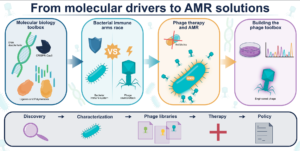
In their natural environment, phages and their bacterial hosts are continuously involved in an evolutionary arms race. Bacteria, on one hand, deploy a multitude of defenses that range from cell surface modifications, restriction modifications, abortive infections, CRISPR-Cas systems, and chemical defense to survive in their niches. Phages, on the other hand, have evolved counter defense measures such as anti-defense proteins and modified receptor-binding strategies to overcome these immune systems. Studying these phage-host interactions continues to reveal novel molecular warfare and immune mechanisms.
Studying phages of multicellular bacteria such as Streptomyces is particularly intriguing. These soil bacteria develop mycelial structures, which differentiate into aerial hyphae and spores, a process linked to the production of bioactive specialized metabolites. Some of these bioactive compounds, such as DNA-intercalating anthracyclines and aminoglycosides, feature anti-phage properties.
Due to their complex, multicellular organization, Streptomyces species use immune mechanisms different from those of single-cell bacteria. As they rely on anti-phage metabolites and proteins, as well as other defence systems, they provide powerful models for studying these interactions.
Satellite phages – the parasites of the parasite
While phages are notoriously known to be parasites of bacteria, their lifestyles challenge the notion of viruses as independent infectious agents. This becomes even more interesting in the case of the so-called satellite phages. These parasites of parasites require additional helper phages to successfully infect and reproduce in a host.
The study “A satellite in the phage universe: Isolation and characterization of six novel Streptomyces phages AndoPrime, Ando, Arkania, Jaresh, Tatooine, and Galidraan” in FEMS Microbes contributes to this phage diversity. The researchers identified six phages as well as a new satellite-helper system: Ando and AndoPrime.
Ando, as the satellite phage, has a genome ten times smaller than that of its helper, AndoPrime. It also lacks tail structural genes as well as host lysis genes, while AndoPrime appears to provide the tail machinery for productive infection.
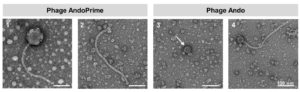
Satellite-helper phage systems are known in other bacteria, including Escherichia coli and Streptomyces. Similar to the known satellite phage Mulchroom in Streptomyces, Ando is temperate, encodes its own capsid structure, and dependent on its helper to produce a tail. This fits the strategy of satellite phages: they reside in the host as integrated prophages until the virulent helper phage infects and provides replication, virion, and lysis components, allowing the satellite to propagate and spread.
World Phage Day and the future of phage therapy
These discoveries go beyond fundamental biology. As antimicrobial resistance is continuously limiting the use of conventional antibiotics, phage therapy is increasingly considered as an alternative.
However, translating these molecular predators into reliable treatments still requires well characterized libraries, robust manufacturing, and internationally adapted regulatory policies. As this study has shown, understanding how bioactive compounds, especially bacterial antibiotics, influence phage-host interactions is the first step towards developing effective phage-antibiotic combination therapies. Happy World Phage Day!
- Read the research article “A satellite in the phage universe: isolation and characterization of six novel Streptomyces phages AndoPrime, Ando, Arkania, Jaresh, Tatooine, and Galidraan” by Kabuu et al. in FEMS Microbe (2026).
 Moses Kabuu is a Doctoral researcher at the Institute of Bio- and Geosciences, Biotechnology (IBG-1), Forschungszentrum Jülich and an affiliated PhD candidate in Biology at Heinrich Heine University Düsseldorf, Germany. He holds an MSc in Microbiology from Friedrich Schiller University Jena and specializes in microbial interactions, bacterial antiviral immunity and antimicrobial resistance (AMR). His current research focuses on bacterial defense strategies against bacteriophage infections, with particular emphasis on defense mechanisms mediated by bacteria specialized metabolites and proteins. Beyond his scientific work, he is committed to strengthening the interface between science, policy, and society by translating research into solutions that address global health challenges.
About the blog
The section #MicrobiologyEvents for the #FEMSmicroBlog reports about events and meetings relevant to our network. These include world awareness days, FEMS-sponsored meetings or meetings of Member Societies and many more.
| DO YOU WANT TO BE A GUEST CONTRIBUTOR? |
| The #FEMSmicroBlog welcomes external bloggers, writers and SciComm enthusiasts. Get in touch if you want to share your idea for a blog entry with us! |