



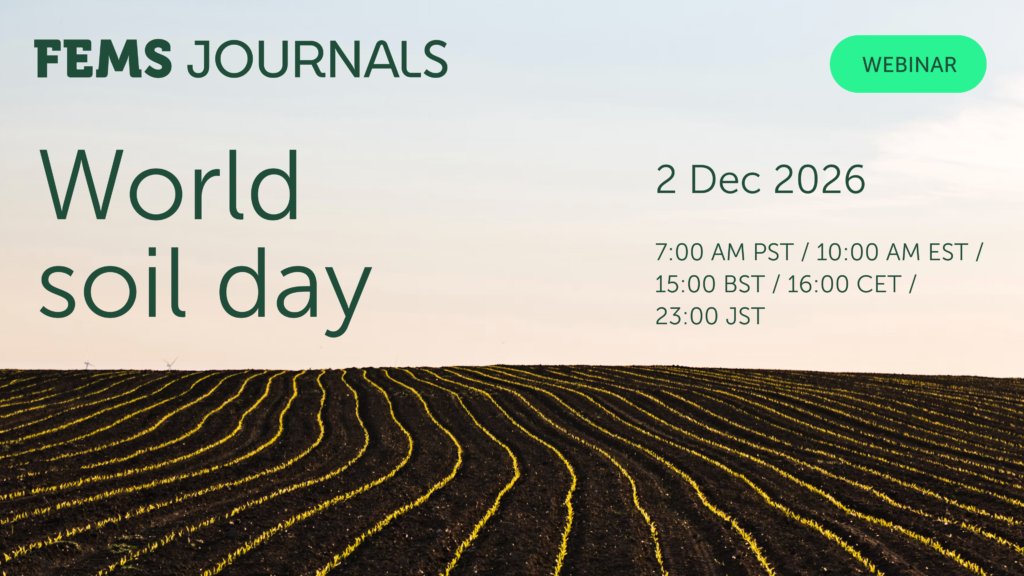
Beneath our feet, microbial communities help sustain plant growth, biodiversity, and soil health. To mark World Soil Day, join FEMS Journals for a webinar featuring authors of three papers exploring these vital connections.
Discover how successive cultivation under drought shapes the wheat rhizosphere microbiome, revealing the complexity of plant–microbe interactions. Explore the global distribution of arbuscular mycorrhizal fungi, whose partnerships with plants support terrestrial ecosystems, and learn why major gaps in our knowledge matter for Sustainable Development Goal 15: Life on Land. Finally, investigate how straw biochar influences microbial communities, enzyme activity and soil properties at different depths in sandy agricultural subsoils.
Together, these studies offer fresh perspectives on soil microbial diversity and its importance for understanding crop resilience, informing biodiversity research, and assessing approaches to improve agricultural soil health.
Please also read the accompanying Thematic Issue in FEMS Microbiology Ecology: Ecology of Soil Microorganisms
Date: Wednesday 2 December 2026
Time: 7:00 AM PT / 10:00 AM ET / 15:00 GMT / 16:00 CET / 23:00 JT
Speakers:
 Speaker 1: Ákos T. Kovács, Leiden University, Netherlands
 Speaker 2: Bethan Manley, Society for the Protection of Underground Networks (SPUN), UK

Speaker 3: Rumakanta Sapkota, Aarhus University, Denmark
Author of: Effect of biochar on extracellular enzyme activity and microbiome dynamics across coarse sandy soil depths
This event is part of a series of webinars by FEMS with OUP funded by the FEMS Journals. The FEMS journals are run by microbiologists, and for microbiologists. Every article published by us has been rigorously reviewed for soundness of science by our community of academic peer reviewers – and the not-for-profit journals support the microbiology community.