


Science thrives on different perspectives. But for science to truly benefit from this diversity, researchers must feel free to be themselves, find a sense of belonging, and build fulfilling careers without fear of discrimination.
For LGBTQIA+ scientists, this process can come with challenges that extend beyond the laboratory. LGBTQIA+ in STEM Day is a good opportunity to not only celebrate their contributions in science but also to reflect on how we can build a research culture where everyone can get equal opportunity to thrive.
Finding supportive communities, navigating questions of identity, and seeing people like themselves in scientific leadership is a good start. For this year’s LGBTQIA+ in STEM day, Prof. Clare Taylor, Editor-in-Chief of FEMS Microbiology Letters, and Dr Michael Sauer, the incoming FEMS President share their personal reflections on life in science. Through sharing their stories, FEMS builds on its commitment to fostering equitable and diversity-friendly scientific communities and encouraging meaningful conversations.
Prof Clare Taylor
Professor of Inclusive Practice and Microbiology in the School of Applied Sciences in Edinburgh Napier University, UK and Editor-in-Chief of FEMS Microbiology Letters
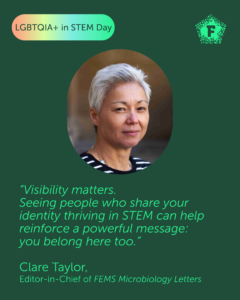 LGBTQIA+ in STEM Day is important to me both personally and professionally.
Supporting LGBTQIA+ in STEM Day is important because science thrives when everyone feels able to contribute, participate, and succeed. STEM disciplines like microbiology are built on curiosity, creativity, and collaboration. These qualities are strongest when we embrace the diversity of experiences, perspectives, and identities that people bring to our scientific communities.
As a member of the LGBTQIA+ community, I know how important it is to feel that you belong. Throughout my career in microbiology, I’ve worked alongside colleagues and students from many different backgrounds, and I’ve seen the positive impact that inclusive and supportive environments can have on people’s confidence, wellbeing, and success. I make a conscious effort to be visible, whether that’s supporting LGBTQIA+ colleagues and students, or serving as a role model for aspiring microbiologists and scientists. Visibility matters. Seeing people who share your identity thriving in STEM can help reinforce a powerful message: you belong here too.
While significant progress has been made, many LGBTQIA+ people still face barriers in STEM education and careers. These can include discrimination, exclusion, lack of visible role models, and concerns about being open about their identity in academic or professional environments. Sadly, such challenges may ultimately lead talented individuals to leave STEM fields altogether. As scientists and educators, we have a responsibility to help create environments where everyone feels welcome, valued, and respected, and I am committed to helping create these spaces. Small actions, such as using inclusive language, challenging discriminatory behaviour, promoting diverse role models, and ensuring equitable opportunities, can have a meaningful impact. Creating a culture of belonging benefits not only LGBTQIA+ people but everyone within the FEMS community.
LGBTQIA+ in STEM Day is an opportunity to celebrate the achievements and contributions of LGBTQIA+ scientists, educators, researchers, and students, while also recognising that there is still work to do. It is a chance to reaffirm our commitment to building a STEM community where everyone can thrive.
As a leader within the FEMS community, I am proud to support and advocate for a scientific culture that values diversity, champions inclusion, and enables people to bring their whole selves to their work.
–
Dr Michael Sauer
Head of Department and the incoming FEMS President (starting January 2027)
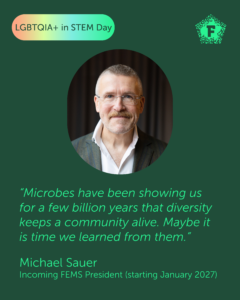 As a microbiologist, I am suspicious of monocultures. Microbial species hardly ever live alone. They live in communities in which very different organisms share resources, cooperate and compete, and take over each other’s tasks when conditions change. Together they do things no single species could do. Such communities look chaotic at times, but they are remarkably productive and resilient.
I believe the same is true for scientific communities and for every other places where people work together. Different identities and backgrounds bring different questions, and it is often the unexpected question that moves science forward. A group in which everybody is alike may look orderly. But is it creative? Is it resilient? And is diversity in the group photograph really enough, if some of the people in it do not dare to say who they are?
As a gay man who has spent most of his life as a foreigner, I know how much it matters whether you can simply be yourself at work. At the same time, I belong to one of the most privileged groups in science, and many LGBTQIA+ colleagues carry far more than I do, because of their gender identity or the colour of their skin. In some countries, and at some stages of a career, speaking openly can have real consequences.
Nobody has an obligation to be visible, and I would not ask it of anyone. However, I think those of us who can be visible should be. It may mean a lot to a student who is still wondering whether there is a place for them in microbiology.
I would like to see FEMS be a community in which everybody feels at home – in the lab, in the lecture hall and at our congresses. As the incoming president, I will do my part to make that happen. Microbes have been showing us for a few billion years that diversity keeps a community alive. Maybe it is time we learned from them.
–
Let’s build a scientific community where everyone belongs
A strong scientific community is one where researchers feel valued not only for their contributions, but also for who they are. For LGBTQIA+ scientists, seeing others navigate successful careers while being open about their identities can offer reassurance, encouragement, and a sense of possibility. LGBTQIA+ in STEM Day is a reminder that building an inclusive research culture requires more than recognition on a single day. By listening to and learning from one another, we can help shape a supportive community where future generations of scientists feel welcome and empowered.