



Yeasts are well-known producers of bread, beer, and wine as well as fuels, chemicals, and medicines. Scientists have become especially interested in the lesser-known species Komagataella phaffii, Yarrowia lipolytica, and Ogataea polymorpha and their remarkable metabolisms for many biotechnological applications. Yet, developing an efficient microbial cell factory takes more than adding extra genes or metabolic routes. That’s why the review “Transcriptional regulation: efficient genetic engineering tools for non-conventional yeasts” in the Thematic Issue “Fermenting the Future: From Bread to Breakthroughs” in FEMS Yeast Research outlines innovative tools and dynamic regulatory systems to control transcriptional frameworks for next-generation yeast cell factories, as discussed by Shabana Haneef. #FascinatingMicrobes
Yeast as microbial cell factory
Engineering yeast cells to efficiently produce desired products requires effective tools to modulate gene expression and control metabolic pathways. The major challenge in such a task is to balance increased production with cellular fitness.
Extensive overexpression can lead to intermediate accumulation, cellular toxicity, and cellular burden. Conversely, lower or weaker expression levels may not be feasible.
On top of that, an ideal yeast cell factory needs to detect changes in the environment, adapt its growth, and turn on production at the optimal moment. For this, transcriptional regulation is becoming a way to program cellular behavior. Tools such as promoter engineering, transcription factors, riboswitches, inducible systems, and CRISPR-based regulation can be integrated to provide the necessary control.
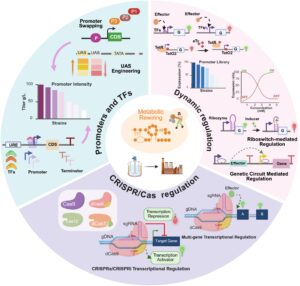
The minireview “Transcriptional regulation: efficient genetic engineering tools for non-conventional yeasts” in FEMS Yeast Research discusses how researchers can precisely control gene expression in these emerging cell factories.
Orchestrating genetic control using various tools
During metabolic engineering, the goal is to optimize gene expression to balance and optimize metabolic flux and improve the production of target compounds. Promoter engineering aims to tune or regulate promoters, use transcription factors, and apply inducible gene expression systems. Strategies to achieve these include random mutagenesis to generate or replace genetic sequences, modify binding sites, and create hybrid sequences.
Another option to regulating gene expression focuses on transcription factors and dynamic control systems. Key targets for temporal regulation of specific genes are binding sites and upstream regulatory regions. As such, transcription factor-based genetic circuits allow gene expression to be turned on or off in response to stimuli, while feedback regulation uses metabolic signals to fine-tune expression based on cellular needs.
Additional tools related to transcription-factor-based regulation include tetracycline-responsive switches and auxin-inducible systems. For constructing genetic circuits and logic gates, riboswitch platforms are the most suitable approaches, although they have been less explored in non-conventional yeast.
Additionally, CRISPR is both a gene-editing and a precise genetic regulation tool. Modified Cas proteins, such as dCas9 and Cas12a, enable targeted gene regulation through CRISPR interference and activation.
Overall, dynamic transcriptional regulation controls gene expression in a temporal, tunable, and reversible manner, while programmable systems offer versatility and allow flexible tuning of several parts of a metabolic network simultaneously. These developments open doors for sustainable biofuel production and novel biotechnological innovations.
Why do we need better yeast cell factories?
The yeast biotech field is currently shifting from static engineering to dynamic, responsive control. A yeast cell’s activity during fermentation is constantly changing: nutrients, growth rate, metabolic needs, and stress levels are in constant flux.
To predict regulatory element behavior and design pathways that adapt to the cell’s changing state, future microbial factories will likely combine AI-guided engineering, high-throughput screening, multi-omics, biosensors, and dynamic feedback systems. However, more complex systems are not necessarily better. For industrial biotechnology and large-scale fermentation, regulatory systems need to be stable, affordable, scalable, and practical.
The review emphasizes these challenges as key steps toward turning laboratory innovations into economically viable biomanufacturing. Ultimately, the aim is to engineer yeast cells that produce more in a smarter way.
- Read the review “Transcriptional regulation: efficient genetic engineering tools for non-conventional yeasts” in the Thematic Issue “Fermenting the Future: From Bread to Breakthroughs“ by Haneef et al. in FEMS Yeast Research (2026).

Shabana Haneef is a PhD scholar at the Dalian Institute of Chemical Physics, CAS, China. She graduated in biochemistry from Quaid-i-Azam University, Pakistan, and worked at the same university as well as at Alpha Genomics Pvt, Limited, Pakistan. She is currently working on synthetic biology and the metabolic engineering of Komagataella phaffii, focusing on developing an inducible gene regulatory system, promoter engineering, and transcriptional regulation to enable precise cellular control and sustainable bioproduction. Her work aims to bridge fundamental yeast biology with practical applications to construct microbial cell factories.
About this blog section
The section #FascinatingMicrobes for the #FEMSmicroBlog explains the science behind a paper and highlights the significance and broader context of a recent finding. One of the main goals is to share the fascinating spectrum of microbes across all fields of microbiology.
| Do you want to be a guest contributor? |
| The #FEMSmicroBlog welcomes external bloggers, writers and SciComm enthusiasts. Get in touch if you want to share your idea for a blog entry with us! |